Aloha, classmates! Not much news this cycle after a rather full one last magazine.
If you can believe it, planning efforts are underway for our 50th Reunion in 2021. Volunteers are needed to work on outreach and planning. Please contact Kate Quigley Lynch ’82, P’17, ’19 (klynch@wesleyan.edu) if you’d like to be involved.
I heard from Georgia Sassen, who reminds us that Harvard, in this case, is the town in Massachusetts, not the university. She is still in private practice in psychology, part-time, and now has more time for her poetry. She received a grant from the Harvard Cultural Council to give a reading there called “Ancient and Contemporary Women of Harvard: Poems in Their Voices.” She directs the nonprofit Building Resilience in Kids (BRIKontheweb.org) as her pro bono public mental health work.
Katy Butler has a Facebook group called Slow Medicine. It deals with issues of dying with dignity. She is the author of Knocking on Heaven’s Door, a must-read about the dying of her father, Professor Jeffery Butler, then her mother. Katy has a new book coming out, The Art of Dying Well: A Practical Guide to a Good End of Life. Check Amazon for release.
Over Memorial Day weekend I was on the Big Island (far from the volcano) in Kona. I was a delegate to the Hawaii State Democratic Party Convention (or the “Dump Trump Confab”). One of my fellow delegates was the illustrious Russ Josephson ’70. I still think it’s some kind of sign that the class of 1970 and 1971 class secretaries should live less than one mile apart on a remote rock, the most isolated rock on earth, in the middle of the Pacific Ocean. Are we a metaphor for how estranged our classes are from the main body of classes? Hope not. Anyway, being this is an election year, all the Hawaii politicians were present. Since Hawaii is virtually a one-party state we got to meet our next governor and other state leaders. Just love life here. Easy to make yourself heard and effect change.
I challenge you as you read this to send me an e-mail with news about you. Aloha for now.
Neil J. Clendeninn | Cybermad@msn.com
PO Box 1005, Hanalei, HI 96714
Aloha, everyone. Greetings from Catastrophe Central, Mid-Pacific Division. Not a lot of news came in this time. For a while it looked like it was going to be “The Steves Column,” then it mutated into “The Steves, Roberts, and Jeremy Column.”
Steve Masten attended wife Ann’s 45th reunion at Smith. They married when she was a junior, so my calculations are they’ve been married 46 years. Wow, congratulations! Afterward, Steve and Ann visited with Charley Ferrucci ’69 in Connecticut. “Also had dinner with Wayne Slitt ’69. It’s always good to be reminded where you came from.”
Steve Talbot, who’s prolific on Facebook, posted that a friend “. . . talked me into walking the Path of the Gods, high above the Amalfi Coast. And like a fool, I agreed. The hour or so hike straight up from the town of Praiano to the rocky trail nearly did me in. But once on the relatively flat path it was all worth it. A spectacular view of the coastline. Precious few tourists on the trail, at least in May. The main person we encountered was a young Italian gardener who trekked up the mountains every day. Descending endless steps to the coastal road tested the old knees, but I was revived by a large glass of pure lemon juice, fresh squeezed from the prized Amalfi citrus. Straight, no chaser. [Wife] Pippa, meanwhile, was doing yoga moves down below, and we glimpsed Positano up ahead. Our total round trip: 10 miles and the equivalent of walking up 157 floors, according to my know-it-all phone.”
And the third Steve is Steve Ching, now retired from medical practice and living on the west side of Kaua’i. We run into one another from time to time. Last contact was Steve inquiring about a contractor to do some concrete work as part of a home remodeling project. (Hope it comes out as planned, Steve.) Meanwhile wife Mary was traveling “as our son and daughter-in-law are expecting their first child.” (Congratulations!) Steve says he’s trying to adjust to retirement.
Speaking of Facebook, Bob Stone, aka Robert Mark Stone, continues to publish his Trumpericks regularly. He took a short hiatus while on photo safari in Africa (from where he posted gorgeous photos), but he’s now back and writing. So much material!
And Rob Baker of Park City, Utah, and an occasional Kaua’i visitor, reported, “Our daughter Emily (Whitman ’02) and her husband Micah (Conn College ’06) had our first grandchild, Eli Patton Blazar, this May. We have been hanging out in Del Mar, Calif., for the event. I’ve found time to surf the North Country, too.”
Jeremy Serwer reported “. . . some 70-ish craziness, two-fold: (1) I had the honor of being accepted to this year’s FBI Citizens Academy in New Haven, a weekly class for eight weeks that introduces regular citizens to all that the FBI does—a public relations effort, for sure, and fascinating.” Jeremy’s conclusion is that “. . . 99 percent of the folks at the FBI are doing amazing things solving crimes, assisting victims and their families, protecting the American people, and honoring the Constitution.”
“(2) Closer to home, I’ve finally achieved the entry level to a relatively new American pastime I’ve long wanted to pursue: Cowboy mounted shooting. While horses and the Old West have been passions of mine for many years, combining six-gun target shooting with western riding is too exciting to describe. This season I’ll finally enter my first matches.” [I admit, one of the more unusual bits of news.]
Finally, Jeremy reports that “. . . wife Nancy is well; she has nine marathons under her belt, and has become a serious weight trainer. She’s truly ripped!”
As for us, we’re getting a new contractor, as the original one has totally folded. Aside from the April flooding (which left us with lots of mud, damaged materials, ruined personal items, and a bit of looting, just for some extra fun), we’re trying to proceed with the long-overdue construction of our house in Kalihiwai Valley. The major road work done last June mercifully held up for the most part. Damage done by an angry waterfall at a water crossing largely has been repaired by a contractor hired by the state to remove major trees lodged against the bridge supports.
After attending the Hawaii Democratic Party’s state convention recently (along with Neil Clendeninn ’71), I took a bus to Hilo and was able to see the volcanic eruptions on the Big Island (about 12 miles from our former home) by helicopter. (Some flooding photos sold to the Honolulu Star-Advertiser helped pay for the flight!) As is typical with me, I have posted lots of photos, both of the flooding and of the volcano, on Facebook.
REMINDER: Our 50th Reunion will be here in no time on May 21–24, 2020. Contact Kate Quigley Lynch ’82, P’17, ’19 (klynch@wesleyan.edu) if you’d like to be involved in the planning. “Ah, but I was so much older then, I’m younger than that now.”
Don Jennings, who grew up in Old Saybrook but now lives in Sudbury, is looking for a second home near us. “I’ve been buying and selling stamps for decades and do some estate planning and zoning work.”
Steve Darnell watched the lacrosse game where Wesleyan became a national champ.
Jeff Richards “has three productions going—American Son, The Lifespan of a Face, and a national tour of Fiddler. I’m energized by the work and creative people.
“Saw Bill Edelheit, Peter Cunningham, and Harry Chotiner, also Alan Metzger ’68, Charles Irving ’70, Dave Rabban ’71, and Peter Michaelson ’71.”
Bill Sketchley’s “disability is discouraging but not fatal. I would enjoy more cultural events and state parks, maybe even Pat Kelly’s resort. I have a ramped van and hire drivers. Life’s expensive. Anybody know a good alternative to cash?”
Nick Browning’s first grandchild, a boy, arrived Mother’s Day. “I still play basketball several times a week, though my body regularly reminds me of its age.”
Doug Bell’s 1-year-old grandson is “a happy young man. I had breakfast with Harry Nothacker, who is a top Ironman athlete. Still friends with Curt Allen ’71, with whom I once played a lot of music.”
Pam and Rick McGauley “led a three-generation trip to Disney, with 4-, 5-, and 7-year-old grands. Everyone is still talking. After a long Cape winter, it’s gardening time. Daughter Louise and family are moving to town.”
Charlie Elbot “coaches school principals at educational workshops. My wife and I traveled to Yucatán and Canyon Badlands, Arches, and Monument Valley. Elliot Daum ’70 visited us in Denver.”
Tony Mohr reports, “All’s well in the courtroom. Beve and I spent three weeks in Japan, no agenda other than hanging out.”
Charlie Morgan “lives in Bonita Springs. We visit New Jersey to see three children and nine grandchildren. I’m busy with insurance consulting and running the Hungerford Family Foundation. Play tennis almost every day.”
John Bach “continues tilting at windmills. Now it’s the nuclear arms race.”
Jim Adkins “works part-time as an ENT doc and plays trombone and euphonium every week. My wife of 41 years has pulmonary problems. Daughter and grandkids, 4 and 7, spent summer here. Kids running around the house is a trip.”
Steve Knox “is practicing law and collecting grandchildren.” Both he and Ron Reisner “enjoyed the Wesleyan men’s basketball golf outing in June. After greetings from Coach Kenny, we joined Dick Emerson ’68 and Pat Dwyer ’67, Jack Sitarz, Brian Silvestro ’70, Bob Woods ’70, Joe Summa ’71, and Jim Akin ’72. Great Wes day.”
Steve Mathews “saw Dave Nelson and Bill Currier. Witnessed the eclipse with Jim Weinstein. Did an American Cruise Line tour of the Revolutionary War sites around Chesapeake Bay. Best to all intrepid ’69ers.”
Steve Hansel looks forward to Reunion next year. “Right now, I’m chairing Eclectic Investment Management.”
Alex Knopp “completed my 11th year as a visiting clinical lecturer at Yale Law School. I’m president of the Norwalk Public Library. Bette finished her first novel. Daughter Jess teaches in the child development center at Norwalk Community College. Son Andrew writes scripts for made-for-TV movies.”
Pete Pfeiffer writes, “The years have not been kind to our class. So many friends have passed or are passing slowly into the twilight.”
Rameshwar Das gardens, leads meditations, and works with wife Kate Rabinowitz ’83 promoting art and wellness for school children through the annalyttonfoundation.org.
Kate and Barry Turnrose “celebrated our 48th anniversary. Steven Crites married us. Dave Farrar, Harry Nothacker, and Ron Reisner the groomsmen.”
Visakha and Ken Kawasaki sent greetings and news from their Buddhist Relief Mission.
John de Miranda taught at Nanjing Foreign Language School as part of a UC Berkeley program.
Siegfried Beer “retired from ACIPPS, the only organization of its kind in the world, ending a 40-year career at the University of Graz. Wesleyan was a major influence in my life.”
David Siegel “teaches medical students as part of an emeritus position at UC, Davis.”
Ian Vickery writes, “Deep in the Ozark forest, surrounded by children, grandchildren, turkeys, deer, and bear, it seems a million miles from Middletown. There is another life, and we are living it.”
Jeff Wanshel writes, “Went up to Memorial Chapel on March 27 to attend a celebration of the life and work of late great poet/translator Richard Wilbur MA’58 Hon.’77. While at Wesleyan (’57-’77) Dick won the Pulitzer and National Book Award and co-founded Wesleyan University Press. His graceful Moliere translations were performed everywhere. An unfailingly kind man and generous teacher, Dick nevertheless did his damndest to set writing students on the good path (excellence). I was lucky enough to take courses from him twice.
“Poetry at the time was broadly divided into two camps, so-called ‘academics,’ where Dick was perhaps paramount, and such wild men as Ginsberg, Creeley, and O’Hara (the ‘new poetry’). Dick was friends with all, negotiating these mined straits with unflappable ease. And soon Wes Press, under Dick’s guidance, pioneered a third way, exemplified by Robert Bly’s ‘Silence in the Snowy Fields’ and James Wright, a poetry observant of nature and ‘things of this world,’ but newly open to the ‘deep image’ of Spanish-language poets such as Neruda and Vallejo. David Orr, reviewing Dick’s final collection, Anteroomsin the New York Times, wrote that Dick had ‘spent most of his career being alternately praised and condemned for the same three things’— for his formal virtuosity; for his being, ‘depending on your preference, courtly or cautious, civilized or old-fashioned, reasonable or kind of dull’; and finally for his resisting a tendency in American poetry toward ‘conspicuous self-dramatization.’
“As the celebrants ably demonstrated, reading his work and reminiscing, Dick is warmly remembered, and his poetry much more than ‘holds up.’”
John Barlow’s life was celebrated in April at San Francisco’s Barlow Memorial Weekend—his graduation from meatspace.
John Boynton, whose twin, Ralph, died last spring, is a principal at The Townsend Group, raising capital for investment products that reflect his global vision.
Maurice Hakim ’70 and wife Carol are restoring an historic home in Clinton, Conn. We do something together almost every week.
John Mergendoller ’68 visited as part of his 50th. He has retired from educational consulting to pursue musicmaking.
Celebrated 49th anniversary. Will never catch Gordy and Dona. Wes is where it began. Can’t/wouldn’t change anything. Eggs Benedict at Mersina’s. Cut flowers in odd vases for condo friends. So glad summer is here.
We lost Geoff Gallas in June of 2016 and Doug Wachholz in January of 2017. Geoff held a master’s from Harvard and a doctorate from USC. He worked for many years in the Philadelphia area in court administration—much of that time as dean of the National Center for State Courts, a nonprofit dedicated to improving the quality of judicial administration at all levels nationwide. Wink Wilder and I were recently talking about bouncing about the country the summer of 1967 and enjoying Geoff’s hospitality in Palos Verdes, Calif. Captain of our swim team, he was then a classic southern California lifeguard. [A graduate of Syracuse’s Maxwell School, Wink actually found the California lifestyle so to his liking that, after a couple of years in Washington, he spent his banking career—and still lives—in Pasadena. Retired and a widower, he summers in Maine near one of his kids.]
Doug was a transfer student from West Point who went on to UVA’s law school and then clerked for a federal judge in the eastern district of Virginia. During the Carter administration, he served in USAID’s Africa bureau and later on with an early renewable energy initiative in Latin America and the Caribbean. (He spoke Spanish and Portuguese.) He then embarked on a career as an international consultant with projects throughout South America. In 1999, he moved to Reno, where he practiced law and expanded his consulting.
Dave Gruol, Dick Emerson, and John Andrus ’67 saw Wes’s basketball team take down then-number four Middlebury. John was a trust officer with several large banks and is now retired in Mendham, N.J., where he served on the town council for over 20 years. Patricia ’79 and DickCavanagh are watching their daughter flourish at Bowdoin—a really sweet school these days—where she is stroking the varsity. They live in Chestnut Hill and, after a stellar career, he is “concluding a decade of failing retirement”—chairman of the boards of BlackRock Mutual Funds and of Volunteers of America, a part-time lecturer at Harvard, and a lousy golfer. Just before Reunion, I helped organize and attended a translucent talk on ospreys and menhaden by Paul Spitzer sponsored by the local Audubon Society. Paul said that Ken Kawasaki ’69 and his wife have, for many years. lived near the Kandy Hill Station (a center of life for British tea planters in Sri Lanka since 1846) and is involved with teaching, fundraising, and other humanistic pursuits for a Buddhist monastery.
REUNION (more to follow): Bob Crispin received the Lifetime Achievement Award. We laughed about Bob’s career as Johnny U (for utility) on the baseball team. (The coaches played him wherever there was a need). After some teaching and coaching, he began what became a most impressive career in finance and asset management at Phoenix Life in Hartford. He ended his career as CEO of major chunks—Peru, Brazil, Chile, Mexico, and Latin America—of the multinational ING Group. A regular commuter to Atlanta and New York as well as a frequent traveler to his areas of responsibility from his home outside Portland, Maine (he’s a place in Charleston for “mud season”). One wife, three “kids,” eight grandchildren, and two labs.
Two highlights of one dinner: (1) Serious talk about the utterly amazing faculty we had and the unbelievable interactions we had with them, and (2) not so serious reminiscences with my two bosom buddies from freshmen year: Bill Smith and Bob Svensk. Smitty, a retired ad executive, is still in Southport mostly chasing five grandchildren under the age of 8 who are also in town.
Lovely lunch with Bob Smith: University of Chicago Law followed by a long and happy run on BC’s faculty and eight years as the dean at Suffolk. Three kids—two in Boston area and one in Montana. Dinner with Terry Fralich and Geoff Tegnell: Terry’s first time back on campus so his head was swimming. NYU Law followed by a change in direction—meditation, time in India and the Himalayas—to become a writer/teacher/speaker. Lives in Maine on—and I’ve been there to check it out—a small piece of paradise. Geoff remains Geoff. I don’t believe in auras but I am sure his is glorious. Social studies coordinator for eight schools in Brookline. Told me Peter Cosel, an attorney and grandfather, is alive and very well.
Bob Reisfeld, fellow PsiUer turned Kaiser psychiatrist, reflected on how widely acquainted I am with the class. To that, I replied it is completely self-serving: When we met, you were the most interesting, able and creative group I’d ever encountered. In the ensuing years, you have only gotten smarter, funnier, and kinder. What is there not to love?
Classmates, thanks for the many thoughtful e-mails in response to my group missive to you about athletics at Wesleyan (“notes from the underground”). I “might could” (as we say down south) send you another group e-mail sharing these many, and varied, perspectives. Stay tuned.
As for the more traditional class notes news from classmates, I have a bit to share. In characteristic fashion, I did not hear from Mike Cronan about his having been honored by the bar association in Kentucky, but fortunately his longtime law partner, friend, and fellow Eclectic, Fred Joseph ’65 sent me an e-mail with a clipping about one Charles J. (Mike) Cronan IV. It turns out that the Louisville Bar Association honored Mike by naming him the recipient of the 2017 Judge Benjamin F. Shobe Civility and Professionalism Award. The award is given to “an attorney who demonstrates the highest standards of civility, honesty, and courtesy when dealing with clients, opposing parties and counsel, the courts, and the public.” That indeed is the Mike Cronan I remember.
Other news? Jim Kates keeps on keepin’ on, with a new translation of a book (I Have Invented Nothing, the selected poems of Jean-Pierre Rosnay). Jim also won a $1,000 prize, the Kapyla Translation Prize, for his translation of Paper-Thin Skin by Aigerim Tazhi, a Kazakhstani woman poet who writes in Russian. The judge for this prize had the following nice comment about Jim’s work: “J. Kates manages to skillfully translate the depth of Aigerim Tazhi’s poetry along with the words, a rare achievement; one hears the resonance of the original in the nuances of the translation.”
Tony Caprio is president of Western New England University, and has been in that position since 1996 (a real accomplishment, I can tell you—the average tenure for college presidents these days is six-and-a-half years, down from eight-and-a-half years a decade ago; since 1996, there have been four presidents at the college where I teach).
Steve Sellers, my old roomie, and his wife, Martha Julia, have made the move from most of the time in Boston and some of the time in Guatemala to most of the time in Guatemala with visits to Boston. They rented out their place in Lexington, Mass., and their primary residence is now the house they built in Antigua, Guatemala. Both their daughter (Sylvia) and their son (Oliver) still live in the Boston area, so they come back to visit. They didn’t exactly leave the country because of Trump’s election, but Steve does tell me that “the bellowing and blathering of the current administration is a little more bearable from a distance.”
Jim McEnteer lives in Quito, Ecuador, with his wife, Cristina, who teaches sociology at Facultad Latinoamericana de Ciencias Sociales (the Latin American Social Sciences Institute), a graduate university, and their two sons. He continues to write. For those of you who don’t remember the late 1960s, his recent article in Salon might jostle a few brain cells. It is titled “My Long Strange Winter Trip with John Perry Barlow[‘69]” and published online on June 2, 2018, at salon.com.
I heard from Charlie Green, who caught me up with the following e-mail: “I am still practicing law at the firm I helped start in 1980. I am not working as hard, but still showing up. Nancy and I will have been married 50 years this August. One of our two sons graduated from Wes, as well as his wife. We have four grandchildren, three girls and a boy. We have lived in Fort Lauderdale for over 45 years.”
In addition to some thoughtful comments about athletics at Wesleyan, Steve Duck shared some information about his life since our 50th Reunion: “Since that wonderful weekend, I have retired. I enjoyed the suggestions of my classmates to ‘wait six to 12 months’ before deciding on a new direction. I am not there yet, but I know that ‘decide’ I will. I have completed an app [Apple Store] that focuses for persons with diabetes, how the state of medicine suggests they need more insulin if they consume a hearty amount of protein and fat in their diet. That felt good. I am believing that the best way to avoid despair regarding the current political environment is to get active in working for a progressive candidate for Illinois governor. I am also still growing and learning how to parent my 16-year-old daughter while at the same time enjoying my two grandchildren! I am grateful for my life and its journey. Hope to see you soon.”
Seems like good sentiments to end with (“grateful for my life and its journey”).
Bill Dietz writes: “Hardy Spoehr is a class treasure. Many of you already know that, but I did not appreciate what a treasure he is until we had a lengthy visit with him and Joyce in Hawai’i. Nancy and I were on Maui in late December for the wedding of our son’s best friend since second grade, and moved from Maui to Oahu for an additional vacation. We had gotten in touch with Hardy to arrange a visit, and he became our tour guide for the island of Oahu.
“His immersion in Hawai’i and its history is extraordinary, fed in part by his parents’ interests and engagement with the island. His father was an anthropologist who studied in Micronesia, so Hardy and his sister lived in Saipan and the South Pacific as children. His father became the director of the Bishop Museum (1953), a fabulous museum located on the original grounds of the Kamehameha School. The museum is dedicated to the history of Hawai’i, and his mother developed a chart of the genealogy of the Kamehameha royal family that is on display at the museum as well as at Queen Emma Summer Palace. Hardy was an early advocate of the need to focus on the health of native Hawaiians. For 25 years he was involved with Papa Ola Lōkahi, the Native Hawaiian Health Board, established by the native Hawaiian community and chartered by the federal government to oversee planning, training, and educational initiatives focusing on improving the national health and wellbeing of native Hawaiians.I was fortunate to have lunch with several of his successors—their respect and admiration for Hardy was palpable.He was also the executive assistant to the Kaho’alawe Island Conveyance Commission, asking for the return to Hawai’i of this island near Maui that was used as a weapons range until 1990.
“Here are a few other insights (among many provided by Hardy) from our visit. Hardy’s piping comes from a long history of English engagement with Hawai’i. Piping grew out of the interaction of Scots with the Hawaiian Islands, and Hardy has written a detailed history of piping (Upoho Uka Nui O Kekokia — Scotland’s Great Highland Bagpipe). As he points out in his book, Hawai’i’s first national anthem was God Save the King, and Hawai’i Alohais set to the tune of a traditional Scottish hymn. The Hawaiian flag has a Union Jack in the upper left corner, and eight red, white, and blue stripes representing the eight major Hawaiian Islands. Hawai’i still has a number of bagpipe bands, and Hardy is a long-standing member of Celtic Pipes and Drums of Hawai’i. He can be spotted in several of the band’s scrapbook photos. Consistent with the Hawai’i-Scotland connection, the pipe bands and others celebrate Robbie Burns’ birthday. Check out the tune written for his father—Alika Spoehr Hulaby Ka’upenaWong and performed on Burns Night 2018. Hardy was master of ceremonies that evening. Exceptional.”
After a distinguished career of 40 years, Daniel Lang has retired from the University of Toronto where he served “variously” as vice-provost, vice-president, and professor of economics. Well, not really. Shortly after retirement, Dan writes, “the president asked me to stay on as senior policy advisor on a part-time basis, which I continued until his term ended a year or so ago. If anyone is wondering what being a senior policy advisor entails, the serious answer is to sit in the back of the room and listen. The less serious, but also truthful answer, is to sit on committees and attend meetings that the president, for whatever reason, wants to avoid.
“Next, in a new and politically inscrutable twist, the minister of colleges and universities asked me take on a job planning and setting up a budget for a new provincial Francophone university.We are heading into the final lap, after which I can hand this over to a real Francophone. I still serve on the boards of governors of a polytechnic college and Roman Catholic seminary, both a very interesting relief from the pressures of a large international research university. Although, for intrigue, the seminary beats them all.
“I still teach a graduate course in public economics, and supervise a few graduate students, mainly because they are smart, and their research topics are interesting. When ambition gets the upper hand, I publish a paper or two, most recently on the economics of human capital in Mongolia as it shifts from a Soviet model of education to a Western market model. I am not sure the shift was the better choice.
“Diane MA’70 and I spend a lot of time playing bridge and tennis and walking the dog. I am in the later stages of my bridge-playing learner’s permit, but she is sharp as a tack. We have a big eco garden with lots of fruit trees, vegetables, and plants that make bees and birds happy. Diane is the gardener-in-chief and fearless foe of any squirrel or rabbit that dares to trespass. I provide the stoop labor.
“Our kids surprised us. Kate, who was insistent that she would go to college only in Canada, refused to attend any school other than the UofT, which she did. Now she works at Mount Holyoke and recently earned a master’s from Wesleyan. Tim, who wanted nothing to do with a Canadian school, went to Swarthmore, but later got an M.Eng and PhD from the UofT, where now as a sustainable energy engineer. Go figure! Like cats, they always end-up on their feet.
“After taking three long trips into the Arctic in Canada and Greenland, last September we headed for Canada’s west coast. We spent a few days in Vancouver, walking, biking, and taking water taxis to get around. For a North American metropolis, Vancouver is remarkably easy to navigate without setting bum in a four-wheeled vehicle. From there we flew north to Prince Rupert, and next took an all-day ferry to Haida Gwaii, where we stayed in a Haida wilderness lodge in a place called Tlell (population 180) on the northeast coast of Graham Island. The Tlell River was 40 feet out the front door. Fifty yards out the backdoor was the Hecate Strait, which separates Haida Gwaii from the mainland. Haida Gwaii, until recently, was called the Queen Charlotte Islands. It was renamed as part of a reconciliation agreement between the government and the Haida people. The islands, many of which are uninhabited and protected as land and marine preserves, are a temperate rain forest. After a series of protests, unchecked logging of the ‘old growth’ forests came to a stop. The forests and coastal waters were then placed in the hands of the Haida people. We hiked in the forests and along the beaches, and took a Zodiac boat to one of the smaller islands with a Haida ‘watchman’ to visit a deserted village. On the way back our guides, who like most people in Haida Gwaii hold multiple jobs, stopped and recruited us to give them a hand emptying their crab traps. The entire Haida Gwaii experience was like entering a new, different, and endlessly fascinating world. For this spring, we are planning a hike along the Camino de Santiago de Compestela.”
Alberto Ibarguen ’66
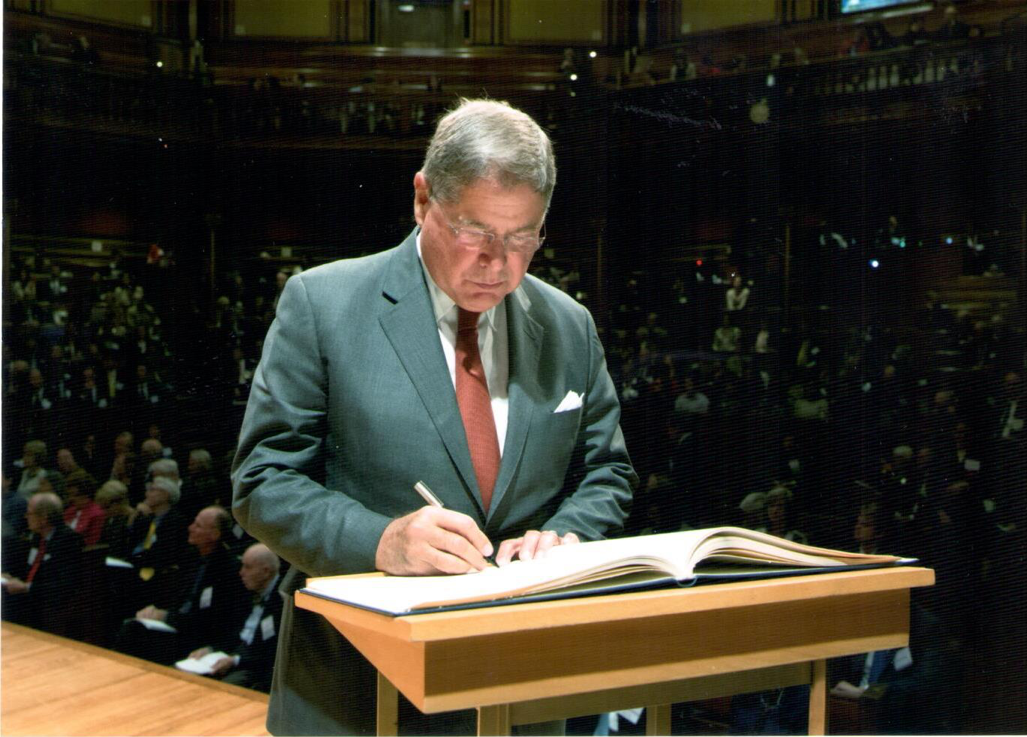
Well-deserved accolades. Robert Barlow is being “honored for his 12 years of service with the naming of the Free Clinic of Central Virginia’s lobby.” David Griffith alerted me that Alberto Ibarguen “was recently made a member of The Order of Isabella the Catholic by order of the King of Spain.” I reached out to Alberto who writes: “Not sure what to tell you about it, except it’s true. I was honored to receive it. It’s right up there with an honorary doctorate from Wesleyan and election to membership in the American Academy of Arts and Sciences (see photo of me signing the ledger first signed to AAAS founder, John Adams).
“I’m lucky and privileged to be healthy and active at the head of Knight Foundation, where we’ve helped Detroit come out of bankruptcy, Philadelphia reimagine many of its public/civic spaces, and Miami become a center for the arts. I’m proudest of having imagined and helped fund and organize the Knight First Amendment Institute at Columbia University, about which you’ll hear more as the laws of free expression on Internet get litigated.
“The foundation was also an early supporter of Wesleyan professor Erika Franklin Fowler’s research into negative campaign advertising. When we started, we had no idea how big a topic this would become until recent elections shenanigans. We’re now one of the foundations supporting teams of independent scholars looking at the 2016 election data. It’s the first-time Facebook has allowed their proprietary data to be examined by outsiders.
“Again, I feel privileged to be able to do this work, and lucky that Susana and I are headed for our 50th anniversary, our son, Diego ’97, is a Wesleyan alumnus and First Amendment Counsel at Hearst, we love our daughter-in-law and have three amazing grandkids. Life has been good.”
David Griffith also takes us back to the Wesleyan team that in 1963 set a New England record for the 400-yard freestyle relay, writing: “Van Kennen was the lead off swimmer . . . and gave us such an enormous advantage that all we had to do was put in a creditable performance to win it. I don’t recall if it was Clark Byam or Thos Hawley in second or third, but I anchored.Dietz was the alternate.” David gives this glimpse of one of our class’s greatest athletes: “VK won the 50-yard freestyle NCAA finals in 1966 . . . an event for swimmers from all schools . . . Yale, Stanford, UCLA, Wisconsin, Indiana . . . VK beat ’em all . . . it was at the Air Force Academy. VK then went up to our family mountain cabin in Alma, and from there he hitchhiked with his skis and boots up to Vail for some serious alpine skiing.”
The day after David’s note, I received one from that very Clark Byam, who lives in Pasadena but often visits Austin, having a daughter there and one in San Antonio. Clark, who as David points out is a “very highly accomplished [lawyer], really,” is “still working at the same law firm, now for 46 years in September, but have cut back on my hours.” He will “be fishing in Alaska in June for a few days and then my wife and I will be in British Columbia for couple of weeks in July.”
Jeff Nilson writes, with characteristic wit, that he is “still taking nourishment and dressing himself,” planting herb seeds, “pray[ing] that they might germinate toSaint Fiacre, the patron saint of gardens,” celebrating with his wife, Marietta, their daughter, Margaret’s, defeat of breast cancer, and taking great pleasure in their grandsons, Isaac (14) and William (11).
Robert Dearth and his wife, Barbara, are celebrating their 50th wedding anniversary this June while keeping up with their grandson, Sebastian, who is visiting colleges this summer. Bob “attended my graduate school’s 50th reunion (Darden Graduate School of Business, University of Virginia). It was a hoot.”
Bill Dietz calls our attention to Willie Kerr’s eloquent description of Bob Rosenbaum quoted in Bob’s obituary (Wesleyan, Issue 1 2018): “His stability in unsteady times, his disinterestedness in factional times, his clarity of vision in beclouded times, his grace in ungracious times helped bring Wesleyan through, not just intact, but enhanced.” Wise words in our unsteady time.
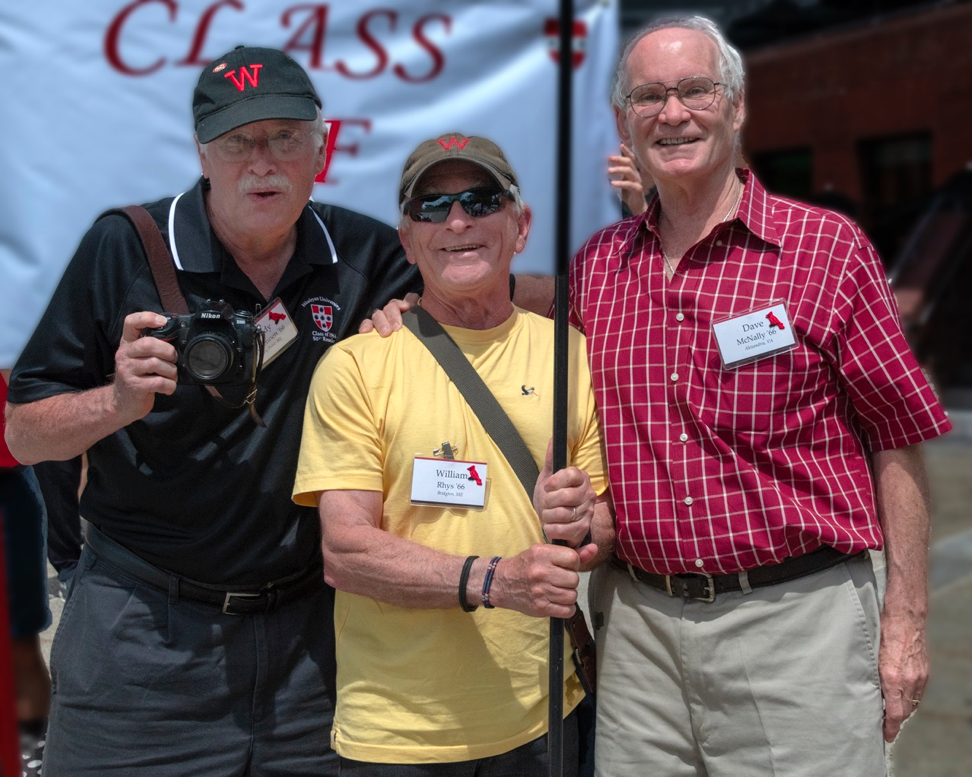
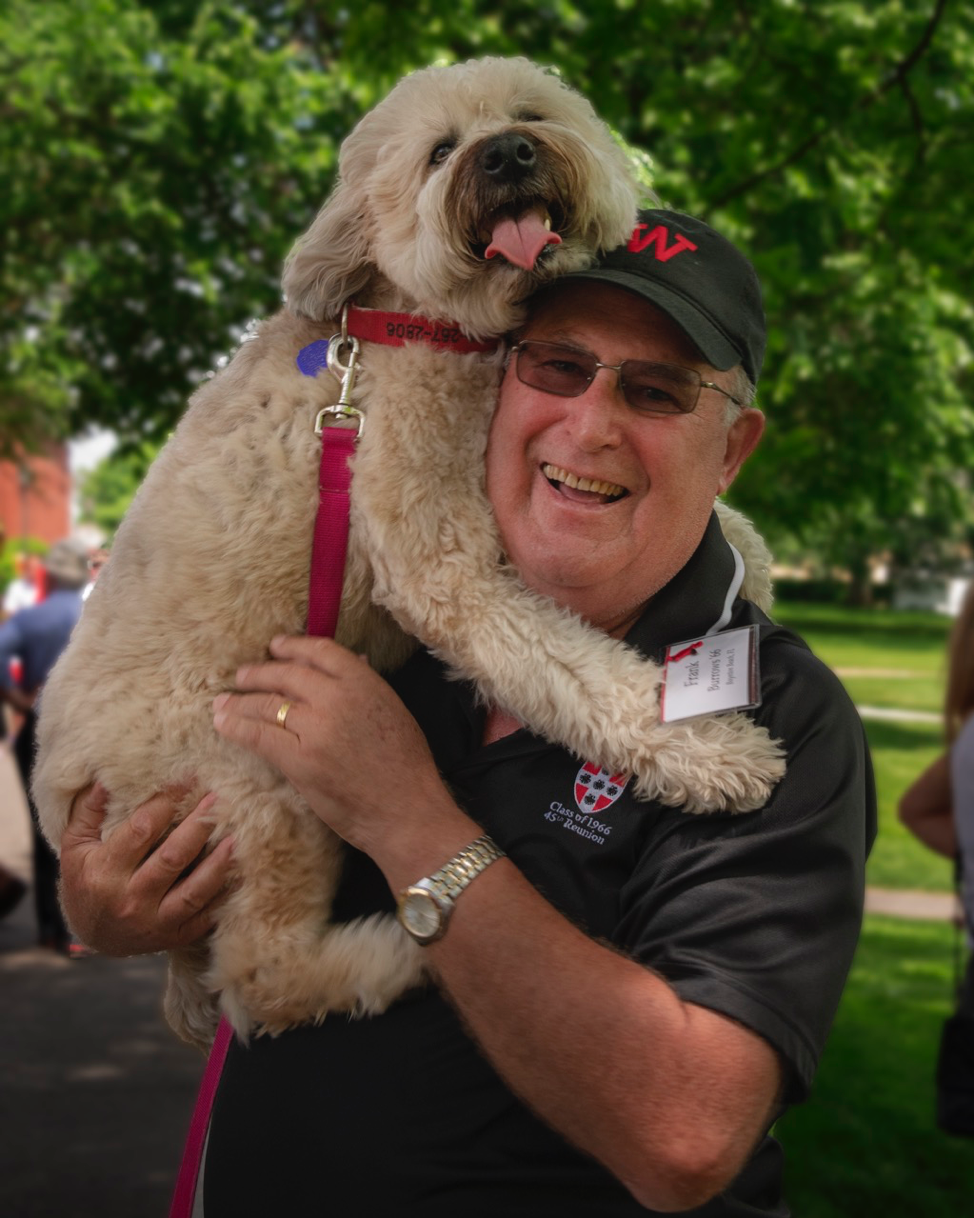
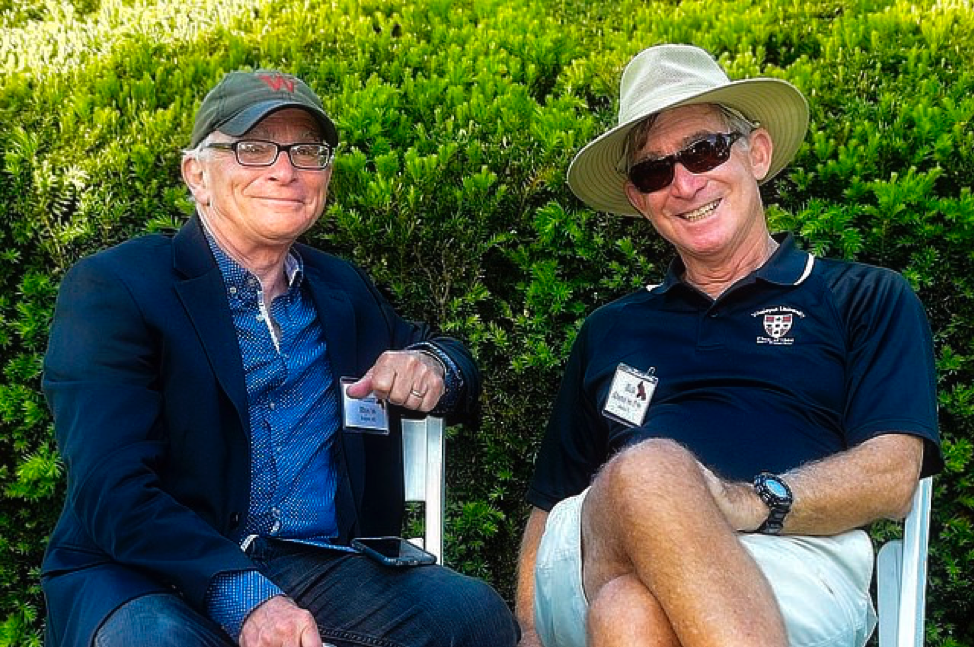
Our 50th Reunion was such a success that a number of our classmates, led by Rick Crootof, thought of getting together for mini-reunions, a chance to catch up while cheering on those celebrating their 50th. As the Class of 1967 gathered in May of last year, I joined Rick, Dave McNally, John Neff, Will Rhys, and Sandy Van Kennenin the celebration. Rick, Dave, Will, and Sandy, joined by Frank Burrows, attended this year’s Reunion, a good time being had by all as you can see from these photographs taken by Rick. Our class seems to be the only one with a significant presence in non-Reunion years. Please think—Hardy Spoehr is—of attending the 50th Reunion of the Wesleyan Class of 1969 and the mini-reunion—we hope a perennial event—of the Class of 1966 in May of 2019. (Photos below by Rick Crootof)
Dear Classmates, it was a pleasure seeing Bill Blakemore in March at an event celebrating the late Richard Wilbur MA’58 Hon. 77, in Memorial Chapel. Bill’s remarks were wonderful, as you’d expect, and highlighted a moving evening of remembrance. Professor Wilbur, former U.S. poet laureate, recipient of two Pulitzer Prizes and the National Book Award, taught at Wesleyan from 1957–1977 and is fondly remembered. Among Bill’s reflections was the fact that Mr. Wilbur had a profound effect on himself and on a number of our fellow students, including Bill Hunt, the late Sam Davis, and the late Spike D’Arthenay ’64. NPR covered the event, which you can find at npr.org.
Win Chamberlin provided this recap of his recent trip to Haina, Dominican Republic, with Habitat for Humanity: “We pushed loaded wheelbarrows into the house and poured a cement floor where there had been only dirt. The house was made of wood salvaged from shipping crates. We painted the inside white and the outside yellow. Our family was a single mother who had three adorable sons. Because of our work and the generous support from Habitat for Humanity, she has a bathroom, a floor, and a painted home. Her life is transformed.
“Haina is one of the 15 poorest municipalities in the country with nearly 65 percent living at or below the poverty level. The average annual income of the families served by Habitat Dominican Republic is $2,400. But the people are attractive, happy, and self-sufficient. They left us charmed and full of gratitude for the warm welcome we received from their community.” Wonderful report and work, Win!
Mary Ellen and Dave Dinwoodey were on campus in April for the dedication of the impressive new tennis courts on Vine Street and for the inaugural match, the nationally ranked women’s team versus a talented Tufts squad.
Terrific day (Cards were victorious) and a number of generous contributors to the project honored former standout Wesleyan tennis players, including Mike Burton and Fred Millett (recognized through Mary Ellen and Dave’s gift).
Dave and Jim Bernegger recently got together for lunch and then saw a performance at the Boston Conservatory in which Jim’s son, Quinn, had one of the lead parts. Quinn, who has a very impressive tenor voice, is finishing up his opera program at the conservatory and wants to make opera singing his career.
Fred Newschwander has published A Day in the Life of a Country Vet, a book I thoroughly enjoyed and recommend. (It is available on Amazon.) Fred has now retired but remains active in number of veterinary organizations and has been honored for his enormous contributions to his profession and to countless animals and their owners. Fred writes, “I sadly noted the passing of the two Wesleyan faculty members who had the greatest influence on my life at Wesleyan: Bob Rosenbaum and Dick Winslow ’40. I did a 10-day horseback safari in Botswana this spring where we rode about 15 miles per day to different tent camps. Enjoyed a boat/elephant tour of nature preserves in India in early 2018. The skiing and snowmobiling season has arrived, but I must admit it is getting harder to drag myself out into the cold.” Thanks for writing, Fred, and great job on the book!
As reported in the last issue of the magazine, Kirt Mead passed away last fall. Mary Ellen and Dave Donwoody attended Kirt’s memorial service in December and wrote his touching reflections of that event: “The service was held in a smallish Episcopal church in the very lovely waterside town of Marion in southeastern Massachusetts, where the Mead family has a summer home. Every available seat in the main church was taken, along with overflow in an adjacent smaller chapel. I’d estimate a good 250 people or more.
“The service itself was beautifully delivered with lovely reminiscences by Kirt’s two daughters and his two brothers, classical music by a string quartet, some poetry and hymns, and reflections of the presiding minister who clearly knew Kirt well. You would have quickly recognized from your own experience the Kirt Mead whose life was being celebrated: A prodigious intellect; an independent thinker unafraid to take a solitary position; and a man with a deep curiosity about most everything. In my own mind, I kept hearing a description of the quintessential Wesleyan graduate. The service had the effect of making me feel more deeply the loss of a classmate with remarkable talents.
“After the service, we headed a few blocks over to the water and the town’s primary yacht club, where Kirt was an active sailor and member, for a reception. We spoke with Kirt’s wife, Susan, who’s doing pretty well under the circumstances. She was very appreciative that we had come to the service, so I was glad that we had decided to make what proved to be a pretty modest effort, only a bit over an hour each way. I told the family that those of us who had worked with Kirt on our 50th believed that he had seemed to come full circle and had renewed his attachment to the current Wesleyan, and they all shared that same impression. Interestingly, I ran into Gar Hargens there. Gar had been visiting his son in Newton and came to the service before flying back to Minneapolis.
“Yesterday’s service for Kirt causes me to reflect upon the growing importance of the extended friendships that we are blessed to have with one another.”
Finally, during my annual trip to South Carolina for tennis, I stopped in Conway to see Coastal Carolina University Chanticleers play the University of Louisiana at Monroe. The game was played on Vrooman Field, named in honor of John, the school’s long-time coach, professor, athletic director, and administrator. Unfortunately, John and wife Deborah were on a cruise to France and missed an exciting game won by CCU 17-16 with a walk-off homer in the ninth.
It’s finally May and I’m in a new recliner in my condo here in historic Savannah. We have a lot back in central Florida with a park-model RV, where we plan to spend a little less of our time than in Georgia.
My wife, Becky, and I just returned from an auto trip made up to Wesleyan, and satisfying my wife’s bucket list stopping over in Niagara Falls on a circuitous route home.
The reason for going to Wes was to be present for the addition of Steve Humphrey ’63 to the Wesleyan Baseball Wall of Fame. I had caught each of his pitching games in 1963 and 1964. I didn’t make it in previous years, when Peter Sipples (shortstop), Phil Rockwell ’65 (pitcher), and Jeff Hopkins ’66 (pitcher and hitter) were added to the wall. Unfortunately, Steve didn’t make the occasion, but he sent a letter to Jim Dresser ’63 to read on his behalf. He was honored and acknowledged his catcher, Teddy Manos, who never had a passed ball, Paul Brands (first base), Lou D’Ambrosio (second base), and Peter Sipples along with Roy Fazendeiro ’65 at third base. We won the Little Three Championship in 1963 and 1964 and were invited to the NCAA northeast region playoffs both years, but Wesleyan turned the invitation down. These days Wesleyan teams are motivated to qualify for postseason action.
I didn’t know most of the people at the reception and dinner, but I easily bonded with the Wesleyan baseballers from the late 1950s classes. There was Dave Darling ’59 and Tom Young ’59, both having been added to the wall in recent years. William Bixby ’56 was at our table, who was one of six added to the wall this year.
I’m sorry to add the news that Richard “Chip” Smith Jr. passed away recently, and it was a personal loss for me as we were fraternity brothers. He was an excellent student in his years at Wesleyan, and his life of political activism started with his participation in campus activities.
Charles Allen Crum also passed away earlier this year. This news was sent to me by his children, Elissa and Townsend, and their sentiment and information reflected their love and respect for their dad. He graduated from Cornell Law School, spent his career in NYC, and upon retiring to Ithaca, N.Y., was donating his time and knowledge to his community. His children will miss his humor, wit, and presence, which is a quite a testimony for this good, kind, and gentle Wesleyan alumnus.
On a positive note, I received communication from Mike Angelini, who was “amazed at the passing of so many years, and the richness and the number of memories of those four short years.” He and wife Marie live happily in Worcester, Mass., where he is an active trial lawyer and a contributor to his community. He summed up his life as being a very lucky guy.
I look forward to our next Reunion in 2019. I had fun getting together with the class of 1959 and how we shared similar memories of our alma mater. I had fun getting to know the baseball players from that class and realized we played the game with wooden bats. For many decades college baseball has used metal or composite bats.
Our 55th is now history. And it has been a few months since 21 of us gathered to consider our lives then, now, and in the future. Here they are in alphabetical order—Tucker Andersen, Colby Andrus, Harvey Bagg, Gerald Baliles, Howard Black, Dave Buddington, Jim Dresser, Jack Emmott, Doug Evelyn, Bob Gallamore, Fritz Henn, Ronald Herriott, John Kikoski, Dave Landgraf, Stan Lewis, Byron Miller, Bill Roberts, Don Sexton, Fred Taylor, Peter Treffers, and Ron Wilson. We were aided and abetted by John Driscoll ’62, whom we dubbed an honorary classmate.
Prior to Reunion, several classmates (Marty Hatch, Jim Dooney, Russ Richey,Bill Roberts, Dave Landgraf, Harvey Bagg, Jim Dresser, John Kikoski, Peter Treffers, Doug Evelyn, Don Sexton, and I) worked hard at planning our schedule. Kate Quigley Lynch ’82 was our primary planning support staff member at WesU throughout it all.
The weekend began Friday afternoon with a moving seminar led by Bill Roberts on the circle of life and rites of passage, with the focus being on rites for those approaching “elderly” status, which now applies to us. That conversation continued at our class reception that evening.
Saturday’s highlight was a related discussion among ourselves, including many spouses, on the challenges that come at our age. The discussion was both reflective and broad, touching on ongoing education, current personal life experiences, and ideas to add new meaning to our lives. With four classmates who were former Wesleyan trustees among the returnees, we also probed the condition of the University today and its continued vitality in producing critical thinking and engaged citizens.
At lunch for all classes post-50th, we heard from Athletic Director Mike Whalen’83, who talked about the gratifying increase in WesU’s athletic success. We are no longer the doormat of the Little Three. As you may have heard, on Graduation Day our varsity men’s lacrosse team won a first-ever team National Championship for WesU!
On Saturday evening, our honored professors emeriti guests were Richard Buel, Dick Miller, and Mark Slobin. Like at our 50th, we watched a slide show of artworks of 10 classmates (Colby Andrus, Stan Lewis, Tom McKnight, Byron Miller, Don Sexton, Dan Snyder, George Tapley, Bob Travis, Lew Whitney, and Scott Wilson), but unlike our past Reunion dinners, we tried our hand at karaoke and all joined in to sing the Highway Men’s “Michael Row Your Boat Ashore.”
On a sad note, I received word of the passing of Jim Reynolds. Originally from Longmeadow, Mass., he loved athletics and could be drawn easily into the smallest argument about sports, especially with Steve Humphrey. Jim was especially proud of his son’s elevation to major league umpiring. Many in the Lodge and beyond will miss him.
In the next edition of our magazine, I will return to reports of individual classmates, and while at Reunion, I was given names of some who are thought to have never appeared or have not been heard from in these notes for too long a time. I know it’s early but let this be your first invitation to come back to our 60th Reunion. Mark your 2023 calendar for May 25 to May 28 when we hope to gather again. Till then, be careful crossing streets, look both ways, and practice breathing in and out diligently every day.
Toni and Bruce Corwin celebrated their 50th anniversary “surrounded by family and friends including Jay Levy ’60 and Rick Tuttle.” He also writes, “Small world time: Next to our offices in Los Angeles, Dave Fisher’s daughter, Charlie, has opened a chiropractic gym. If you’re in the area and your back is bad, drop in. She’s great!”
Tuli Glasman, retired from the University of California, is a volunteer “spending time with elderly groups (ages 85–100) at the Santa Barbara Center for Successful Aging.”
Sad news is the passing of three of our classmates. Charles Armstrong died in June in Winter Park, Fla. After graduating from the University of Missouri Medical School, he practiced in Winter Park and Atlanta before opening a family medical practice in Alexandria, Va. Jeff Hughes passed away in February in New York where he spent many years in financing and banking with Lehman Brothers, and opened his own private equity firm, the Cypress Group. Fran Voigt died in May at his home in Cabot, Vt., after many years as the founder and president of the innovative and award-winning New England Culinary Institute. Many of us still fondly remember the fabulous dinners that Fran and his students prepared at two of our Reunions. Full obituaries can be found online here. Our condolences go out to their families.