CLASS OF 1966 | 2015 | ISSUE 2

Aloha, all.
By the time everyone reads this, summer will be a remembrance of the past. Hopefully, everyone has had their fill of “soda, and pretzels, and beer.”

This is late in coming, but first I want to recognize our classmate Bill Dietz, who has joined the ranks of our retired after a long and very distinguished career at the Centers for Disease Control and Prevention (CDC). I personally need to thank Bill for his helpful thoughts and advice to a diabetes program I was directing in Hawai`i a number of years ago…a big mahalo, Bill, and welcome to our ranks!

The big news for us is that our 50th is now well over the horizon! Our classmate Rick Crootof has been hard at work twisting elbows and peering in various neighborhoods to put together a great Reunion Committee. The committee is already beginning its work and includes: Rick and Dave McNally as our co-chairs; Jim Andrus, Essel Bailey, David Bartlett, David Boyle, Howard Brodsky, Tom Broker, Al Burman, Frank Burrows, Clark Byam, Graham Colville, Gary Conger, Donald Craven, Pat Curry, Bob Dannies, Bill Dietz, Jeffrey Evans, Steve Giddings, Paul Gilbert, Al Ibargüen, John Knapp, David Luft, Jim O`Leary, John Neff, Irv Richter, Sandy Shilepsky, Pete Spiller, yours truly, Sandy Van Kennen, and Dale Walker and Wes staff Pam Vasiliou, Mark Davis ’96, and Nicky Bennett. Thank you one and all for serving. Rick has notified us that Professor Rob Rosenthal has agreed to be one of our class guests and did a great seminar at our 30th Reunion comparing the top 10 songs of 1966 with those of 1996….Can you imagine what that comparison would look like now? Now it’s up to all ’66ers to do the right thing and to start planning now on attending next year’s gathering. Let’s make singing our old Wesleyan Fight Song at least one more time together a reality on the steps of North College…see you there! And maybe even the Douglas Cannon will show up for another appearance!

The Committee has already been at work and invited Don Russell to join us, and he has accepted. Speaking of sports…congratulations to the Wes baseball team and Coach Mark Woodworth ’94 in winning its second consecutive NESCAC championship, and a welcoming to Dan DiCenzo into the head football coaching position. Thank you, Mike Whalen ’83, for a great job and congratulations in your new athletic director positon.
A final note, and one more somber, is the concern I know we all have for the seemingly ongoing gun tragedies across our nation. This is not meant to be a political statement, I simply want to call to mind how we of the ’60s era at Wesleyan were all so privileged to have lived at a time which witnessed Wesleyan’s involvement in race relations bringing together us as students and Middletown youngsters in tutorial programs; serving as a hub for the Rev. Dr. Martin Luther King Jr.’s efforts in the Middletown/Hartford area and evenings in the Foss Hill dining hall; sending its students to Washington, D.C., to march and to Tuskegee to learn. It also brought future Dean Edgar Beckham ’58 to Wesleyan, whose legacy on campus lives on through the Edgar Beckham Social Justice Award. Let us remember those days for, in many ways, they formed the glue which has cemented us as the class of ’66.

As with other Notes – a final Hawaiian `olelo:
Aia no ke ea i ka puka ihu: “There is breath still in the nostrils”—a reply when someone asks how a friend or relative is.

And so, ’66, our breaths live on!!!

CLASS OF 1965 | 2015 | ISSUE 2

We laughed, we cried, we hugged, we danced, we told stories and said things about ourselves not said before—in short, it was an extraordinary Reunion!

Many thanks to the committee who put it all together and to the 93 classmates—a 50th Reunion attendance record—who returned to our beloved campus.

The university honored a number of our own:

Hugh Wilson: Distinguished Alumnus Award for his remarkable achievements as a mathematician, philosopher, biologist, chemist, physicist, researcher and professor.
Mark Edmiston: Outstanding Service Award for his many years of service to Wesleyan as a trustee and alumni association leader.

Rob Abel, Don Crampton, and John Hall: Wesleyan Service Award for sustained service to the college as fundraisers, alumni club leaders, donors and admission volunteers.

Joseph’s Robe, the ’65 award for meritorious service to the class, was presented to: Gary and the Wombats (John Dunton, Steve Flance, Brooke Jones ’64, Leon Robinette ’64 and Richard Smith), and to Reunion juggernauts Dave Dinwoodey and Bob Barton. (To further sway the judges’ votes in their favor, The Wombats put on a spirited performance on Friday night and we all danced like it was 1965 once again!)

The festivities, which began on Thursday, featured a nice mix of seminars, time for socializing and sports (some of us played golf, tennis, and basketball), and space in the schedule just to relax and walk the expanded and beautiful campus. We also had three enjoyable banquets: a Kickoff Reception/Dinner on Thursday evening; the President’s Reception/Dinner in our honor on Friday, featuring Michael Roth’s ’78 remarks on the state of the University and his vision for its future; and Saturday’s celebratory Class Dinner with Professors Anne and Nathaniel Greene, and Wendy and Karl Scheibe; Coach Don Russell and his son, Andy; long-time administrator John Driscoll ’62 and his wife Gina; and special guest, Linda Burton, widow of Mike Burton.

Seminars and panels featuring the ’65 family included: “Butterfield 2020” organized by Bob Barton, which explored the reasons Wesleyan went from one of the wealthiest colleges in the country to the verge of financial crisis in the 10 years after we graduated.
“Our Times” was an interactive discussion among classmates moderated by Tony Schuman concerning the turmoil of the ’60s—the civil rights movement, Vietnam, the social revolution—and its influence on our lives.

“Skills for the New Economy,” a WESeminar organized by Kirt Mead examined the skills that Wesleyan grads will need in a new economy dominated by technology and rapid change. Presenters included Kirt, who consults throughout the United States and Europe on business leadership and strategic planning, and Molly Barton ’00 (Bob’s daughter), who is a leader in digital publishing.

“Architect as Artisan and Community Activist,” was a WESeminar presented by Steve Badanes regarding his decades of work in community-based architecture and design. Steve is a noted speaker, author, itinerant designer/builder and the Howard S. Wright Professor of Architecture at the University of Washington.

“Global Warming: What the World’s Climate Scientists and Policy Leaders Now Know, Fear, Hope and Plan,” moderated by Bill Blakemore, featured classmate Jerry Melillo, along with Wes Professor Gary Yohe, a leading climate-impact economist. Bill began writing about global warming for ABC News in 2004, and Jerry chaired all three government National Climate Assessments and served as environmental adviser to the President.

(In this regard, a number of classmates attended an informal meeting afterward to discuss ways to encourage University initiatives, such as focusing endowment investments in cleaner energy rather than fossil fuel companies. For more information, please contact Woody Sayre; Robert.Sayre@u-pem.fr

Another major highlight were the three “’65 WesShorts” sessions designed for classmates—scripted or not—to speak briefly about their lives, professions, passions, families, and reflections on their Wesleyan experience. They were organized and moderated by Bob Barton, Hugh Wilson and Tony Schuman and were extremely varied and entertaining. (Most of them were filmed and will be available to the class online—details to be announced.)

Ron Young came back and spoke several times with eloquence and passion. Ron left Wesleyan to pursue a career in civil rights, world peace, religion, and education. He developed a lifelong relationship with Professor John Maguire and met the Rev. Dr. Martin Luther King Jr., on numerous occasions. Here are excerpts from a message he sent to the class following the Reunion: “Warm thanks for welcoming me in the class, despite my not graduating until 1986…. Connecting and reconnecting with many of you, experiencing Wesleyan’s wonderfully diverse community, learning in the Wes Seminars…. listening to the WesShorts…were incredible and very emotional for me. Reading the Remembrances about guys I knew and others I didn’t brought tears…

“Given how significantly my taking off from Wesleyan affected my life, I don’t regret what I did, but I do have a much deeper personal appreciation for what I missed.”

Ron wrote a memoir concerning his work in support of civil rights, opposition to the Vietnam War and efforts to foster peace among Arabs, Israelis and Palestinians, entitled Crossing Boundaries in the Americas, Vietnam and the Middle East.

In addition to the Reunion committee, individual kudos to: Rob Abel and Bob Barton for producing a marvelous 50th Reunion class book;

David Dinwoodey, editor, and the many contributors for their efforts in putting together the touching Remembrances booklet containing personal memories of deceased classmates;

Don Crampton for his tireless and long-time work on the class’s support of the Wesleyan Fund and his committee, for their efforts, as well;

Hal Gorman, Bill Knox, Mike Maloney and Hugh Wilson for their donations of some truly fine wine for our enjoyment throughout the weekend;

Peter Kelman, expert in Web communications, who spearheaded the critical effort to locate lost classmates and to urge all to attend.

Now, thanks to Peter’s ongoing wizardry, coupled with Bob Barton’s wes65stories website, we are well-positioned to build on the relationships renewed and begun at our 50th. And, later this summer, all of us will receive the Class Book Addendum, and those who missed Reunion will also receive the tribute to deceased classmates and Peter Whiteley’s fabulous ’60s CD. (Thank you, Peter! I listen to it all the time!)

This will not be our last class gathering or Reunion! We have a great opportunity to continue to make new friendships, renew old ones and engage each other in beneficial ways for years to come. So, save Nov. 6–7 (Homecoming), the dates for our next get together. Details to follow!

CLASS OF 1964 | 2015 | ISSUE 2

Here I go again, putting together class notes for another issue of our alumni magazine. Where will my thoughts take me, and in keeping with the “this is why” at Wesleyan, I’m looking at our class, a half-century removed from undergraduates, to lend some perspectives to the conversation. I would like to believe that we were led into our future by Wesleyan to have integrity, responsibility, and generosity in the various domains of our lives. I have been back to each Reunion and have been recording my notes on a quarterly basis so that I declare our mission accomplished.

There is a broad range of contribution to the world when you look at the paths we all followed. I’m thinking of our 50th Reunion class book and what was shared about life after graduation. I’m impressed by the physicians, lawyers, judges, and politicians who emerged from the “storied halls;” educators, philosophers, business leaders, and activists who transformed the lives of others.

Recently, I looked at the addendum to the class book and reviewed the comments of Norman Daniels, Richard T. Smith, Jr. (Chip), Joel J. Johnson, The Honorable Frederick J. Motz and Oliver E. Wood Jr. (Chips). Norm Daniels and Chip Smith took the path of social justice in theory and application to the leaders at Harvard University, in Norman’s case, and the labor workforce and union concerns in Chip’s world. Norman studied psychology and philosophy at Oxford for two years. Chip received a degree in economics from Temple University.

Fred Motz graduated from the University of Virginia Law School in 1967 and spent time as an assistant United States attorney, followed by working in a law firm in Baltimore. In 1985 he was appointed a United States District Judge in Maryland by President Reagan and continues to serve his community.

Joel Johnson was originally in the class of 1964 and didn’t graduate until 1965 when his CSS project was extended one year. He spent two years at Princeton’s Woodrow Wilson School. He would be a source of interesting perception in the world of commerce, having worked for the federal government—State Department, Treasury, and Senate Foreign Relations Committee, participating in such activities as UN conferences on Trade and Development. He eventually left government employment and focused on international aspects of aerospace and defense trade and industrial cooperation.

Chips Wood got an MBA in international business at the Wharton School, went to Navy OCS training in Newport, R.I., and served for three years. He joined the Levi Strauss International Division and eventually rose to regional general manager, Asia. He later formed Wood Consulting International to assist companies entering foreign markets, including an enterprise in Russia.

We didn’t have women in our class, but in reviewing the notes on our wives, there is a powerful group of ladies who have been most valuable: Chip Smith’s wife, Kim, a neurosurgeon; Fred Motz’s spouse, an appellate court judge; Norman Daniels’, a neuropsychologist; and Chips Wood, a botanical artist.

Norman Daniels came away from Wesleyan wanting to learn theory acceptance in science.

Joel Johnson remembers Vic Butterfield’s advice to have four exciting years at Wesleyan but not the best years of our lives. Chip Smith was amazed at how much he learned after the first month of freshman year and the intellectual habits he developed. Fred Motz “being grateful not so much for the knowledge that was imparted to me, but for being taught to try to ask good questions.” For myself, I learned to trust my ability to be taught and took on four years at Albany Medical School and earned an MD degree. At Wesleyan I also learned how to be a catcher on the baseball diamond, giving me the tools to be an obstetrician and “catch” thousands of babies.

CLASS OF 1963 | 2015 | ISSUE 2

Tucker Andersen is semi-retired as an investment consultant. While he and his wife, Karen live in Warren, Conn., he spends two-and-a-half days a week in NYC doing consulting work. Karen was the UConn Master Gardener Coordinator for Litchfield County, Conn., for six years. She is now retired and concentrates on enjoying her garden, their dogs and their rural, 200-acre property. In their woods there is an abundance of wild life—coyote, deer, mountain lions (no tigers) and black bears. (Oh, my!) He’s seen two of the latter. Since mountain lions are solitary animals and it wasn’t breeding season and the two he saw seemed somewhat small, he thinks they were juvenile siblings. Tucker is about to retire from the Wes U Board of Trustees but will stay on the investment committee, which will entail his meeting on campus four times a year, as well as joining monthly conference calls for updates. Living in the “wilds”, he’s become “not a real birder” but is beginning to recognize some birds. The Andersens travel via a destination club—Exclusive Resorts which means they can go to wonderful locations—Newport, Kiawah Island, Tuscany, the Caribbean Islands, to name some they visited—and stay in luxurious accommodations. Tucker has run 40 marathons, including the Boston marathon twice. And while he had an entry for the ’13 Boston Marathon, fortunately due to a medical issue he did not run. He did run in it this year. His best time ever was in the NYC Marathon way back in ’78 when he ran a 3:32.43. And in ’13, two months to the day after a robotic prostatectomy, he very slowly completed the NYC Marathon. Happily his last two PSA tests have shown undetectable levels. He organized a mini KNK reunion at Wes U, which Don Sexton and Dave Buddington attended. A non-KNK attendee was John Kikoski, who just happened to be on campus and joined after walking into the room looking for someone else. Tucker and Karen have two adult daughters. Heather uses their Connecticut and NYC homes when not leading bicycle tours for adventure cycling or traveling, and Kristen (Wes U ’95), who lives in Denver, Colo., is a published author of I Never Intended to be Brave, a memoir of her solo bicycle journey through southern Africa.

After many years in New England, David Youngblood has lived for almost 30 years in Lexington, Ky. When I asked him why he moved south, his reply was simple: “I was chasing a lovely woman who is now my wife.” That lady would be Ellen Rosenman who, unlike David, is not yet retired. She is a professor at the Univ. of Kentucky and is writing a book. Her teaching and writing keep her very busy. David taught English for 20 years at Newton South High School in Newton, Mass., (10 years as department chair), and then, once in Kentucky, for another 29 years (23 as department chair) at Sayre School in Lexington. There he generally taught seniors, always an AP class or two, the other grades in English one time or another, and creative writing now and then. When I talked to David in June he had only been retired for five days and was “quite new at it.” But both being teachers, they’d generally had summers off and liked traveling. For their 25th anniversary, they drove the length of New Zealand, north to south. It’s a long way to go and they were eager to see it all. So while it was endlessly spectacular with lovely view after lovely view, in the end they were pretty worn out in that they had not given themselves much time to just stop and rest. Now they factor that into their travels. The Youngbloods have two daughters, one adopted. Ardilla is at V.C.U. in Richmond, Va., studying interior design, and Lizzie, who went to Vassar, works for a NGO in D.C. Both are 26. David still plays some tennis and stays in touch with John Vinton and wondered what had become of Larry Shultes. (Spoiler alert: I will find out for the next notes.) He recounted a vivid memory of his Wes U days: “I was racing back and forth through the halls having a snowball fight with other freshmen when a very irate student jumped out of his room where he had been trying to study and punched me in the eye.” Naturally, being a psychotherapist, I asked him in an understanding and empathetic manner, what he’d learned from that. And naturally, being a teacher, he responded assertively that he’d learned never to throw snowballs in dormitory hallways again.”

From Chambersburg, Pa., David Brill reports that he has been retired for four years from his medical practice in radiology and nuclear medicine. His wife, Elizabeth, to whom he has been married for 11 years, is also retired from being an editor for a religious book publisher. They do some traveling and had a wonderful cruise on the Danube River to celebrate his retirement. They have also visited Tuscany. But he has a special fondness for the American West, where he loves to bird watch. He has introduced Elizabeth to bird watching, which she enjoys but not with quite the passion he has for it. (As I am a birder, too, we talked birding a lot.) He got into birding when on a trip to the Galápagos Islands, he met J.J. Hickey, a renowned American birder who was on the same cruise. Once he learned of Hickey’s credentials, he approached him and they talked birding. From that talk, David said he learned a lot about identifying birds and became interested in getting into birding. As for being retired, he goes to the gym and some Bible studies but mostly he calls himself “a self employed dilettante,” by which he means that what he likes best is just doing whatever he wants—and that is learning about many things that he could not pursue when he was working. He reads very widely in scientific areas outside of his own, especially in the natural sciences. He also likes history and art. He describes many of his days as involving sleeping, getting up, eating, reading and then reading some more. He says that is a payoff from a liberal education, a desire to keep learning. Also he recalled that he had an intellectual inferiority complex coming to WesU from a public school. He thought that he’d be way behind the prep school guys. Unfortunately he did feel overwhelmed and that lasted for about three years until he was told he was the top guy in the bottom quarter of the class. This seemed to fire him up and he says he began to strive to “catch up” and he had a good senior year. After graduation he kept on “catching up” and continued to do so long after others had gotten to wherever their level of satisfaction was and started resting. He never “rested.” That helped him go far in his career and appears to be continuing.

RON TALLMAN from t. Augustine , FL said that right now the big excitement is that one of his daughters from his previous marriage, Kelly Clements has just been appointed Deputy High Commissioner for Refugees for the UN. She started her career in government way back as a Presidential Intern with Pres. George H. W. Bush and now this. She will be moving to Geneva. He has a second daughter, Jennifer who teaches elementary school in SC and between the two he has 5 grandchildren, ages 8-20. Ron retired at a. 61 due to health reasons and it was then that he and his wife, Noel moved from Chicago to St. Augustine, FL. He developed Cervical Dystonia which limits his physical activities more and more now. Prior to his retirement he had been Dean of the College of Arts and Sciences at Roosevelt University, Chicago. Three years ago Noel also retired. she had owned her own ad agency. He’s not sure how the got into it, but they really like going on cruises. The went to Tahiti last year and will go to the Open in the UK this year and then cruise way up the Norwegian coast, perhaps even encountering the newly emboldened Russian navy. And in the Fall they will go to Lisbon and then cruise in the in the Mediterranean. He has fond memories of their exciting encounter with the tail end of a fierce hurricane in the N. Atlantic. Ron played #3 on the WESU golf team but due to his physical ailments, now thinks his golfing days may be ended. He also remembers that he “kind of lost track” academically and being young and “seeking adventure”, he and JOHN BURT (initially of ’64 but eventually of ’65) left WESU Jan. ’62 for Europe and returned Nov. ’62. (Dean Barlow told them he was sure they’d never return to WESU.) They visited pretty much most of Europe, drank “a 1000 bottles of wine, hundreds of bottles of beer and there were all those young ladies to befriend”. The last month of their European jaunt they lived on “.50 cents a day room and board”. A surprised but pleased Dean Barlow readmitted them and he found his lost academic track and actually graduated with the class of ’64. “But I identify with the class of ’63” says he. Ron then went to the University of Maine, got a Ph.D. in Canadian history and eventually became the director of the Canadian-American Center of the Univ. of Maine where he created the largest Canadian Studies program in the US (and the world outside of Canada) with up to 1,200 students per year enrolled in various courses. He was also president of the Assoc. for Canadian Studies in the US for two years as well as a founder and for many years, a board member of the International Council for Canadian Studies which allowed him to travel and lecture around the world.

Appearing for the first time in these notes in decades SKIP SHORT, living in Hamden, CT, has had a very interesting career or rather, careers. Not at all sure what he wanted to do for in life for his first three years at WESU, he took an inventory of his likes and found four areas of interest(1) artistic/scientific problems, (2)construction [“as a kid I was fascinated by construcion sites”], (3)analytic challenges and (4)people. So he decided that architecture would include all those interests and hustled to take courses (especially math) that he’d not needed before and after graduation, enrolled in Yale’s architectural program from which he graduated. While there he began to buy and renovate rundown buildings. And along the way met his first wife who became the property manager for what turned into almost 180 units. Eventually he became very tired of the renovation work so when he and his wife divorced he sold her his half of the units which she owns to this day and which their two children, Matthew, a 36 and Sarah, a. 31 now manage. For the first 20 years after graduation he worked for an architectural firm in New Haven. he eventually left and opened his own private practice for 15 years. But while he really liked dealing with clients, he did not like hassling with contractors or building inspectors and at age 50, walked way from the field. Wondering what to do, he noticed that his bookcase was filled with body/mind books. He decided to take a course in massage therapy at the CT Center for Massage Therapy. He liked it and learned the Trager method of massage which he practiced along with some more conventional methods from his early 50s up to three years ago. He now does a lot of volunteer work. With his architectural knowledge, he is very useful to and active on his 120 unit condo board. He is also very involved in a peer to peer counseling group in CT and an officer of the CT Butterfly Assoc. He recalled that he and ED FINEBERG used to relax while at WESU birdwatching in woods up towards Long Lane School. Skip married his wife Deborah in “01. She is an RN and is a Unit Manager in a Dementia unit.

CLASS OF 1962 | 2015 | ISSUE 2

Travel seems to be the theme for our brief class notes this issue. Bruce Corwin reports that he is renting a house in southern Spain for the entire Corwin family, including nine children and grandchildren, to celebrate his 75th. Apparently family togetherness only goes so far, because he and Toni are following that with a seven-day cruise on their own from Athens to Venice.

Bill Everett and Sylvia this year toured ancient monuments on the Nile. In addition to seeing the Great Pyramid and the temple of Abu Simbel, they joined Egyptian archaeology expert Zahi Hawass in exploring ancient village and tomb sites. They then went on to Cyprus where he continues to work conserving the Skouriotissa copper mine where his grandfather worked and his mother lived as a girl. In non-travel news, his book Sawdust and Soul: A Conversation about Woodworking and Spirituality was published this year.

Finally, Steve Trott reports that Steve Butts and Marian spent three to four months in Paris. No word on whether he made it across the pond for some Irish folk music jam sessions. Steve recently was awarded the Idaho State Bar Association’s first Distinguished Jurist Award.

If anyone has any other tales of memorable 75th birthday celebrations this year, we’d love to see them in the next issue.

CLASS OF 1960 | 2015 | ISSUE 2

We were welcomed to our 55th Reunion by the sound of the bells of old South College. Dave Potts presented a WESeminar, “Only Yesterday? Wesleyan in the ’60s,” that was based on his recently published book, Wesleyan University, 1910-1970: Academic Ambition and Middle-Class America. At the Wesleyan assembly and annual meeting of the Alumni Association, Dave received the James L. McConaughy Jr. Award, which recognizes a member of the Wesleyan family whose writing conveys unusual insight and understanding of current and past events. In his acceptance speech in the chapel, Dave pointed out the stained-glass windows that commemorate past presidents and important benefactors to the university.

Myles Standish received a Distinguished Alumnus Award for his accomplishments at the California Institute of Technology Jet Propulsion Laboratory, where he created and continually improved high-accuracy planetary ephemerides (orbital positions) that are vital to the successful navigation of planetary spacecraft. Those ephemerides are now the world’s standard, providing data to virtually all of the national almanac offices, astronomical researchers, and observatories.

At our class banquet, I led the singing of “Sentimental Journey,” which captured our feelings about attending the Reunion. That was followed by “Goodnight Sweetheart, Goodnight” which reminded us of those fabulous party weekends. The singing of some traditional Wesleyan songs was a fitting ending to the banquet. My thanks to Charlie Smith and Brittany Richard, our liaison on the Wesleyan campus, for all their planning that made it a successful 55th Reunion.

On the day after the class banquet, my extended family had a reunion in Cromwell at the home of my niece, Liz Pulling. With both college and family reunions, it was a memorable trip to Connecticut.

CLASS OF 1959 | 2015 | ISSUE 2

Members of the great class of ’59 and their support forces continue to be actively involved with their families and communities. Ted Fiske and his wife, Sunny, have just returned from London, where they attended a chamber music concert in which Hugh Rosenbaum performed with his bassoon up to his high standard. Ted and Sunny will return to London for the month of October during sabbatical to study the English education system. Sunny’s older son and family also live there.

Hugh Lifson writes from Iowa: “Really enjoyed your report. I am envious of all the meet-ups people are having. Out here in the boonies, Wes alums are rare and classmates even rarer! The get-togethers made me think of your column and President Michael Roth’s ’78 article. I hate to say it, but it is an old Williams College slogan—‘a college is Mark Hopkins at one end of a log and a student at the other.’ Well…. if my memory is correct, we all had such experiences. One dared not go into Louis Mink’s office unless you were prepared to spend an hour or two. The same thing often happened with Profs. Schorske, Tenzer, Greene, Schwarz, McAllester, and many others. I have often bragged about the fact that the Wesleyan education c. 1959 was the best in the country. President Roth may be unwittingly (or wittingly) hearkening back to our golden days.”

Skip McAfee reports from Bradenton, Fla., where he resettled after the loss of his wife of nearly 50 years. They had been in Columbia, Md., for 40 years, where Skip was the executive director of The American Society for Horticultural Science. Thereafter he edited the Dickson Baseball Dictionary, weighing at more than four pounds with more than 10,000 entries. Bradenton appealed as his new location because his younger daughter and growing family live there. Skip is also the umpire of choice for youth baseball and senior softball.

Bill Moody reports on a couple of mini-reunions. First the Messrs. Moody, Chase, Gillette, and Leverich and their spouses met at the home of Bing and Luize Leverich for dinner and tall tales and memories. Bob Gillette told about his new book, a sequel to his first, The Virginia Plan. A second reunion took place at the National Museum of the Marine Corps where Tim Day was honored for his generosity in funding an overlook site named in his honor. For a number of years, Tim has also funded deserving Marine Corps captains at Harvard Business School. Bert Edwards, Ed Murphy and Bill Moody were in attendance.

The oft-wandering Eklunds are still active, having attended two high school graduations, one in Colorado, and the other in New Jersey, a week apart. Cornell and Brown are the next stops for the grads and Dave and Mary will repeat in four years. Dave and Mary are on Nantucket, then to Walpole, Mass., for Dave’s 60th high school reunion. Next to Bristol, R.I., for July 4th to see one grandson march in the oldest continuous USA parade. Then to Jackson Hole. Wow!

We now have two classmates who are members of the Wesleyan Athletics Hall of Fame: Fred Stone inducted last year, and Dave Darling this May. Dave Eklund and Tom Young were there in support in the Silloway Gymnasium! (All that and back-to-back NESCAC champions to boot!) Pictures of the event and the honoree are on our class site, thanks to Mary Eklund!!

Ed Roberts is retiring as the music director for the Lansdowne United Methodist Church after 14 years. He corresponds with Music Prof. Emeritus Dick Winslow ’40 who is now a spry 97. Prof. Winslow walks with two canes and refers to himself as “Citizen Canes.”

On a sadder note, Dr. Jim Browning died in March. He was a highly respected ophthalmologist, keen Steelers fan and renowned gardener specializing in azaleas, rhododendrons, magnolias and dwarf conifers. He propagated and hybridized hardy rhododendron, and had to miss our 50th as he was called on to hold forth at the American Rhododendron Society, which awarded him their highest honor.

Peter Rockefeller remembers Jim: “In the summer of ’58, inspired by Jack Kerouac, Allen Ginsberg and other such visionaries, we bought a used Chevy in Hartford, with the help of Shive Shively, and eventually set off from Jim’s home in Pittsburgh to see the USA!
“We really bonded during our journey and many memories flood back now—his support during an awkward reunion with a no-show father in Florida, our nocturnal hike down the Grand Canyon and back up, staggering to the rim as the sun rose, descent into the Carlsbad Caverns at dusk as bats swarmed all around us, crossing the Mojave Desert in the middle of the night to preserve ourselves and the Chevy, observing the $2 betting limit in Vegas, discovering the magic of San Francisco, crossing the Rockies and peeing on the Continental Divide (doesn’t everybody?), and home.

“Jim was a private man, thoughtful and kind. I cherish the time I was privileged to share with him.”

Blanche Browning, Jim’s wife, responded: “Thank you, to all of you, for your kind words about Jim. Pete, I cannot tell you the number of times Jim talked about your trip, recounted exactly as you described it.

“Wesleyan can be credited for the number of books I counted in his library of Shakespeare’s works, more than 28. He listened every day to lectures of the Great Courses on all subjects: art, philosophy, religion, wars, history, and literature. When he passed away he was reading three books: Joseph and his Brothers by Thomas Mann, Plato and King Lear. He often reread many of his books.

“Finally, he was still working on hybridizing a new rhododendron to be named Wesleyana!”
Our thoughts are with Blanche and the family.

Ed (Dusty) McGrew passed away at the end of May after battling a number of things, including strokes and cancer. He and Carol were married for almost 56 years. Carol was at Conn. College; Dusty was an enthusiastic Alpha Delt and they obviously led an exciting courtship as they were married the minute the ink dried on their diplomas in June of 1959. They raised three daughters on the North Shore of Chicago. There are eight grandchildren, seven boys and one girl who are thriving. Three are college grads, one is studying medicine, and the rest coming along from grade school to high school. Quite a handful and a real achievement!

CLASS OF 1958 | 2015 | ISSUE 2

In early April, Charley Denny, Bart Bolton, Ed Kerschner and I enjoyed a lunch/golf date in Naples. Ed and Bart drove down from Sarasota to Naples, where Charlie and I reside. We gathered for lunch and then nine holes of golf. Mercifully, we did not record the scores, but the company and conversation were first-rate.

Since Randy Johnson left Wesleyan for three years in the army, he feels a part of the class of ’58 and the class of ’61. After Wesleyan he received an MBA from Stanford. He believes he was the first-ever student to use Wesleyan’s first-ever computer. It was the LGP-30, weighed 800 pounds and cost $400 ($40,000 in today’s money).

Burr Edwards reports that he and Bob Hayes tried to connect during Bob’s May visit to southern France. Sadly, they only connected via cyberspace.

Two items from John Corkran. One, his wife, Toni, is having a hip replacement in June, which will curtail summer travel. Two, relative to the 2014–2015 Wesleyan Fund, our class has been very generous this year, although we are always glad for additional contributions.

Roger Turkington has been busy in the intellectual sphere. His first volume of 195 poems has been a best seller on Amazon, and the second volume, Poetry of Passion, is in printing. He explained that since he walks with a cane, he no longer hikes, jogs, or plays tennis.

Some news from Neil Springborn. Golf occupies most of his time along with serving on several community boards. His oldest son has been transferred to Houston to take over as head of the weather bureau there.

Art Geltzer has opened his house on Cape Cod and plans another summer of fishing with Mel Cote and Dennis Allee. In June he and Younghee are going to Rome to follow up his Yale course in ancient Roman architecture. Professionally, he is doing research at Brown in digital telemedicine to improve the ophthalmic data and reduce the cost of providing eye care.

Big news from Roger Van Tassel. On April 17, he married Judith Dufour Love. They were married on their back patio in Mint Hill, N.C.

Tony Codding writes from New Hampshire. Other than taking cruises in January and March to escape the N.H. winter, his main activity has been leading a six-month long-range planning process for St. Andrews-By-the-Sea in Rye, one of New Hampshire’s nine Episcopal summer chapels.

Dick Goldman and his wife, Patti, returned from Florida on March 31. This spring he participated in three seminars for the Boston Bar Association. Two involved commercial real estate leasing and financing. He chaired the third, which dealt with the use of mediation in disputes involving closely held and family businesses. In addition to his practice he is now preparing to teach at Boston University Law School for the fourth fall in a row.

I received a very creative e-mail from Rick Pank. His theme was “baseball.” Like a “favorite mitt” he says he is finally well broken in, tennis and running becoming kayaking, biking and hiking, all keeping him in the game. His “home base” is Rowayton, Conn. (48 years), which was voted the sixth happiest coastal village in the U.S. He “keeps his eye on the ball” doing fine art photography and helping the Rowayton Art Center compete in the art league of Fairfield County. He “rounds the bases” with a mixture of nomadic trips of his own design, mixed with Road Scholar expeditions filling their head in the great Wesleyan tradition. In his “final thoughts on the game,” Rick realizes that it is not necessary to “hit the ball out of the park.” “Small ball can also win games.” That is, those who do not travel can still be happy and fulfilled.

I speak often to Art Levine and Ted Wieseman, who are in the Washington, D.C., area. Arthur and Barbara recently traveled to Antarctica and parts of South America. Art has limited his golf activity due to back issues.

Ted is doing well. He was in an assisted living facility, but recently is living independently.
Bob Furber observes that on June 16, 2016, Van Vleck Observatory will be 100 years old. He recalls having two instructors, professors Stearns and Gasteyer, for one course in which he was the only student. That class took place in Van Vleck.

CLASS OF 1957 | 2015 | ISSUE 2

The column features tales of grandchildren and Reunion headgear. I’ll lead off with Jeff Williamson reporting from Madison Wisc., on his and Nancy’s six grandchildren. Sarah ’16 returned from junior year study in archaeology at UCL in London, and Erin starts out at Middlebury. Nancy attended Erin’s graduation from high school in Berkeley, Calif., while he stayed home to attend A.J.’s ceremony. Neil and Maya are in high school, and Alex is the youngest. The Wiliamsons spent much of the summer at their vacay home in Newfield, Maine. They plan to attend Sarah’s Wes graduation; Jeff has saved the ’57 cap and expects to wear it at one or more Commencement events.

Dick Cassie writes of completing a three-day faculty stint in oral diagnostics at Rutgers’ School of Dental Medicine. He met two Wes graduates studying there. Escaping from the fierce winter of ’15, he headed south to Florida, played golf in Tampa and then moved on to Delray Beach, visiting with Roger Toner. Dick now makes his year-round home in Bedminster, N.J., in a high-rise condo, commenting that he’s as “happy as a Jersey clam at high tide,” a unique real estate testimonial if I’ve ever come across one. Of course when he wants to experience authentic seashore life, he can be found at his summer retreat on Long Beach Island. His grandchild tally numbers three, one in college and two in high school.

Bill Shepard and wife Lois traveled on a lengthy Mediterranean cruise this past May. Bill was a guest lecturer, offering talks on destinations such as Marseille, Provence, and the Amalfi Coast. Stops also included Corsica, Monaco, Barcelona, and Rome. He said he was tempted to try his luck in a casino in Monaco, betting on number 22—said to be the lucky number in Casablanca but backed away from such a heady commitment (perhaps the favorite wager of the usual suspects?). Bill adds that this time the couple went “incognito,” mentioning that a year ago in St. Petersburg (Russia, that is) his ’57 cap was much in evidence. Well, our cap is bold red, is it not?

A note from Al Kalb finds him enjoying his 16th year of retirement and still swimming for recreation. He has eight grandchildren, with two of them in college, one at Colby and another at Emory.

Find Whitey Johnson and wife Paula enjoying Mt. Holyoke and Wes reunions cherishing “…old times, old friends we hold to you, hands joined…” (that is right out of the song book—“Campus Memories”). We can count on Whitey for ’17! Bob Smith and Betty Smith went up to Montreal this past May to attend games at the Women’s World Cup, along with two of their sons. All are strong soccer fans. Bob stays in touch with Jerry Baker and his wife, Peggy, and George Davies and his wife, Dusty.

Yours truly and Joan weigh in with “My Three (grand) Sons”, Johnny, 15, Wil, 13, and Tommy, 6. The oldest served as his h.s. freshman class president and plays second base on the frosh team. Will is into track and Tommy is a standout KG grad. Oh—the cap—I wear it in summertime when driving my red Solara convertible with the top down. Its condition has just the right seasoning for the occasion, and I, too, am saving it for our 60th. I hope that all of you are doing so as well, for when we convene in 2017.

CLASS OF 1956 | 2015 | ISSUE 2

George here. As I reported in the magazine our classmates were more than generous in sharing their news. Mind you; we can receive more news than we have space to print, but never too much to appreciate. So here is what you missed.

Incidentally, I began my appeal for news by expressing my reservations about social media in general to elicit opinions on the subject from our fellow 56era. And, in this informal and very unscientific inquiry, a substantial majority of my respondents apparently agree. Even Bill Moyle, who pointed out the obvious flaw in my logic (grandchildren), wrote, “Otherwise, I do about the same as you.  I don’t have that much time to waste.” Those who didn’t respond evidently were too occupied with texting, posting, and tweeting to bother. They’ll still be welcome at our forthcoming reunion, as long as they promise to look up at least now and then from their small screens.

I’m leading off with Jim Gramentine because he’s been trying valiantly for the better part of a year now to get this story, and it’s a good one, into the class notes.

“Shortly before we boarded mid-afternoon on January 27, 2015, Nancy, a friend we had made over the previous ten days, told my wife that she had a ‘strong feeling of impending doom.’ We were passengers on the Discovery, a three-decked catamaran, numbered 19 and the crew nine.

“After touring Tobago Island, we crossed the bay back to Panama City harbor. As night fell, we were moored perhaps a ½ mile from the shore and ¼ from the entrance to the canal. First course had just been cleared; virtually all of us had glasses of wine as well as water, when a strong wave hit the side of the ship I faced from the head of one table. Then another, then a stronger, then the mother of all harbor waves put the small catamaran at a ?? degree angle. I thought we were going to capsize. Most of the guests (average age 75?) and their chairs fell to the floor along with nearly all of the glasses.

“I grabbed Sarah by the shoulders, preventing her from falling (or was it for the sake of my own stability?), also saving my glass of wine. Pandemonium for two, three minutes; people with cuts, bruises, perhaps one concussion, but no one hurt seriously. The crew responded magnificently. The captain later explained the cause as a huge jet boat that almost hit us. Plantains instead of the rice dish in which they discovered glass. Drinks on the house but paper cups. Sarah asked Nancy if the event had been her ‘impending doom.’  Nancy supposed it had.

“So ended our most memorable overseas adventure. The next two days we enjoyed a calm but highly interesting passage of the Panama Canal.”

Here’s a more tranquil report from Betty and Larry Labrie.

“We are now grandparents of seven. The last four have come two at a time! Beth likes to tell that our second child, who with his wife had our three oldest grandchildren one at a time, did it the ‘right way.’ Our oldest son and his wife had twin girls in 2008, and our daughter (the youngest child) and her husband had twin boys March 7th. We were there the day after the births to help for two weeks or so and sent home to rest. Needed lots of rest and are back with them in PA for a week plus. The boys have grown and weigh over 11 pounds each and doing more laughing and smiling.

“I am still in the carving class at the local community college in Morehead City, NC carving decoys and enjoying it. Doing less on the lovely beach here in PKS and more visits to the doctors.

“Enjoyed being with you a year ago at Wes. Looking forward to our 60th reunion year.”

Find the common denominator in these two reports.
From Bob Calvin:

“Always nice to hear from you and Bob. No social media, limited use of on line devices? I think you are moving away from your Chinese heritage . [What??? G.C.] Every month Art Von Au and I correspond. He sends me a wonderful hand written note on a tasteful greeting card, and I send him an email filled with local activities and views on world events. Email vs tasteful hand-written card. Therein lines the contrast between digital and analog. I probably enjoy his notes more than he enjoys mine.
“I am teaching entrepreneurship courses on line now at Novoed.com which is part of Stanford. I prefer the class room experience that I enjoyed for 30 years at the Graduate Business School at the University of Chicago, but online courses allow me to interact with students in Russia, China, Brazil, and Africa. Jane and I are planning a trip to Italy and France this fall, and hopefully we will take it. Bob Buckley, our classmate, is teaching Jane French. We visit our daughter and grand daughter in NYC several times a year.

“Time seems to be speeding up. Days turn into months and months into years very quickly. I have less patience than before, and I never had much.

“Peace.”

And Dick Bauer: 
“My take on the new digital technologies is about as enthusiastic as yours. Fortunately my wife, Ginny, protects me from this particular deficit—some others, too….Health pretty good given the age thing—bicycle regularly; walk at better than a waddle pace, but not much better. Remember our life-sport requirement: golf or tennis? One of these days I really should try them out….Presented on the privacy vs. security problem for a Great Decisions program, and led a couple of discussion groups for Life Long Learning using Atul Gawande’s Being Mortal (along with other materials). Relevant for our age cohort….A very happy bit of news—Art and Rosalind von Au moved into our CCRC a few months back! See them pretty regularly. Now, if we could entice a few more of you to come to Linden Ponds…”

It’s Art von Au, of course. Hey, Art! Drop us a line one of these days!

Barry Passett is a kindred soul, not just with me.

“George, I’m with you 95% on social media:  I had to let myself agree to LinkedIn because some friends asked. but then I realized it was a mistake and I don’t check it (even when Don Ritt tries to send me stuff.)  You are not alone! [Don’s the one who told me to ignore LinkedIn! GC.]

“I am spending half my time going to doctors for my ailments and the other half trying to provide counsel to friends and acquaintances on how to navigate the health system.  Some of the smartest people turn to mush when a doctor tells them to do something, no matter how stupid it is.  They don’t question, and they don’t argue.  Often that means they get hurt.  Almost everyone I know has had a hip replaced, half have had knees done. I don›t believe there are that many diseased joints in Washington (well, excluding the Capitol of course.)  And so many back surgeries, where the success rate may soon hit 50%.  Anyhow, mine is useful work.  Despite (or maybe because of) all that, I did get an Honorary Lifetime Membership in the American Hospital Association.”

I promised more from Fred Boynton. 

“I share your aversion to social media, partly as a hangover from when the security officers on our government contracts used to advise us not to be overexposed.  I also haven’t received a copy of the Wesleyan Alumnus in years, and wasn’t sure you were still in business.

I am retired (about five years now) and live in La Jolla with my wife Beverly.  We have two sons and four grandsons.  (I was one of four boys.  Something seems to be barring the second X chromosome.)

“Beverly and I have been traveling around North America.  In 2009 we drove to Alaska, hit the usual tourist spots and then took the ferry back to the lower 48 along the Inland Passage.  In 2012 we drove across the US to Virginia, where my surviving  brother lives, stopping on the way in Kansas City for my 60th High School reunion.  We have also made some wine tours along the West Coast, from San Diego to British Columbia and points between.

“Our sailboat has become a ‘harbor queen.’  I considered selling it earlier this year, but an acquaintance has taken over the maintenance in exchange for his use of it from time to time, so I remain a boat-owner for now.”

By the way, Fred sent me his Tales from the Annals of America. I’ve only been able to sample it so far, but so far so good!

This was the unkindest cut of all! I’m embarrassed to say that I left out the best part of Don Price’s communiqué.

“You may remember that, in my senior year, I had a hard time deciding between medicine/science and the humanities. Thanks to support of Fred Millet and Norman Brown I was offered a scholarship to Columbia to study with Jaques Barzun. However, I decided to attend medical school. ‘The Road not Taken’ (Frost). Over the past several years, I have begun to walk back up the humanities road and started to give talks on literature and the brain. For example, next week at the Hopkins Biennial, I am speaking on ‘Dementia: From Shakespeare to Alzheimer to 2015.’ The idea goes back to C.P. Snow’s two cultures which I discussed with Fred and Nobby so many years ago. In this enterprise, I have been encouraged by many friends, including George Ray ‘54, great Shakespearean scholar. We, our wives and other friends, including Dan Josephthal, get together to see performances at Blackfriars Theatre in Staunton, Va. A great venue/company and our favorite theatre; over several decades the ASC/Blackfriars program has allowed us to see virtually the whole Shakespeare canon live.”

Right on!

And speaking of Fred Millett, Walt Ebmeyer, commenting on my claim that I proofread my email, made this observation. “Being an old Fred Millett baby, I worry a lot about typos and misspellings and bad grammar.  Where, after all, are standards?”

Where indeed?

Thanks to all.

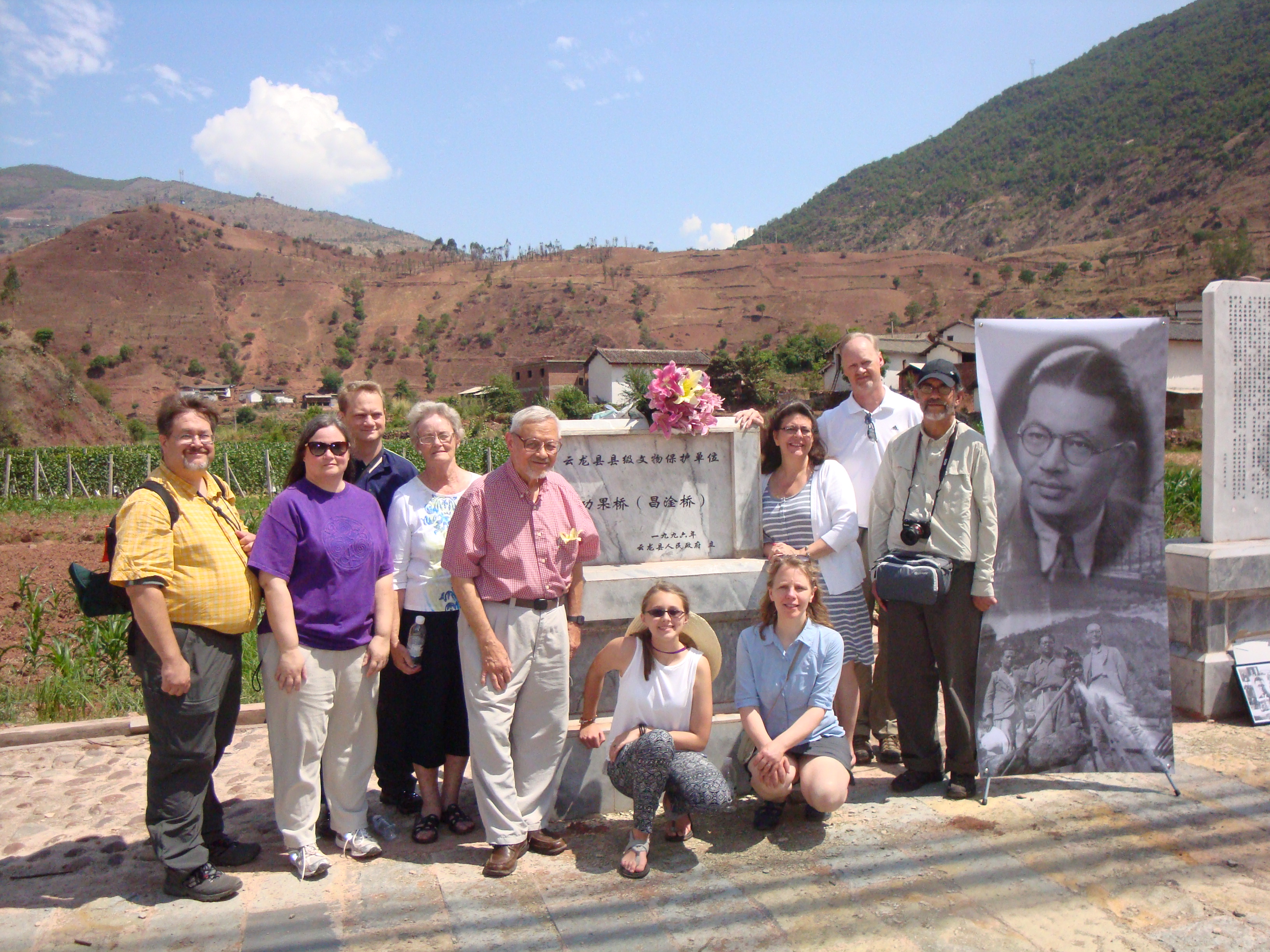
Assembled Chiens at the Bridge 2015 Chang Kan Bridge [1)

I’m also attaching two photos from our trip to China. One is of the rebuilt bridge itself; the other is of the assembled Chiens by the bridge’s historical marker: Left to right: nephew Chris ‘83, daughter Judith ‘64, son Paul, Ann and George ‘56, (kneeling) granddaughter Jeannette and Dan’s wife Becky, daughter-in-law Cheryl and son David, and nephew Dan. My father, Chang-kan Chien is pictured on the right.

ON THE ROAD

We all kick the can down the road from time to time. But every once in a while, we must stop to take stock. That happened recently at my GADZOOKS early morning coffee club. One of the guys commented about my shiny new, blue Toyota RAV4 car parked just outside the door. Sitting to my right, Fred asked,
“Well, Bob, how old are you?”
“Eighty,” I said.

Without dropping a beat, Fred replied, “Well, that was your last new car purchase.”
We all laughed knowingly because Fred was prescient as always. With that purchase, I dropped out of the great American car chase. I won’t be kicking my can down that road again.

Many other travel journeys must also soon come to an end. I cannot say this better than our ever-mindful Don Ritt, M.D., who resumes his many notable contributions to ’56 Class Notes, with the brief memo below:
Dear Bob
Admittedly, I am obsessed and driven but now that I have given away my endoscope and concentrate on Palliative Care and end of life situations, I plead with you to remind our classmates that they are now 80 years old and that time is running out. Please remember, tell them, that they should complete their end of life directives and POLST documents (to avoid chest compression, intubation and tube feedings). It is okay to talk about death; it’s a very common event. Tell them to remain in control.
Best wishes,
Your visionary, aka, d ritt

I believe that a Google search of POLST is good place to begin the process advised by Don above. When I did that, I came up with this:
“A growing number of states are promoting Physician Orders for Life Sustaining Treatment (POLST) Paradigm Programs, with the goal of helping physicians to better respect their patients’ wishes for end-of- life care. The tool turns an advance directive into actionable medical orders, allowing seriously ill patients to specify choices about certain interventions, giving patients more control of what end-of-life care they receive.” (Medial Ethics Advisor, April, 2013).

It may seem like I am leading you into another deep cave during income tax season (this note prepared in March). And to be candid, it is no short or simple task to address the complex End of Life issues on our plate. Complex questions emerge: What advance directives? Which patient’s rights?, What about a timely case-by-case diagnosis?, Can a hospital or family member assert final authority?

Although people have been dying for some time, it just so happens that the public health, medical, cultural, economic, and ethical landscapes have been changing big time in recent decades. It’s no longer about your “father’s Oldsmobile” as people said long ago. We must each become conversant with the new realities of dying in America.

I just purchased a highly acclaimed, recent book entitled, BEING MORTAL: Medicine and What Matters in the End, by Atul Gawande, 282 pp. This paragraph rang my bell:

“But this is an unsettled time. We’ve begun rejecting the institutionalized version of aging and death, but we’ve not yet established our new norm. We’re caught in a transitional phase. However miserable the old system has been we’re all experts in it. We know the dance moves. You agree to become a patient, and I, the clinician, agree to try to fix you, whatever the improbability, the misery, the damage, or cost. With this new way, in which we together try to figure out how to face mortality and preserve the fiber of a meaningful life, with its loyalties and individuality, we are plodding novices.” (p. 193).

I thank Don Ritt for introducing this important topic to our Class Notes discussion. I hope you have found this note appropriate and instructive.

In any event, you are encouraged to send George and me your comments, considerations and personal stories. Let us resolve to plot a buoyant future course, while preserving memories that bring honor to our lives and family legacies.

George here. I fervently hope that Doc Ritt and Bob will stir us octogenarians into action.
I’d like to kick in my two cents worth.

My great uncle Frank H. Ryder, Wesleyan Class of 1900 and a trustee of the college for 50 years, lived a full and productive 91 years, actively involved to the end in countless organizations. At a dinner with my mother he revealed what kept him going. He had something scheduled for every day—always something to look forward to. Not knowing that it was to be his last, he told her that it had been a perfect day. He died that night.
Get your POLST documents in order, folks, but mind your calendars, too.