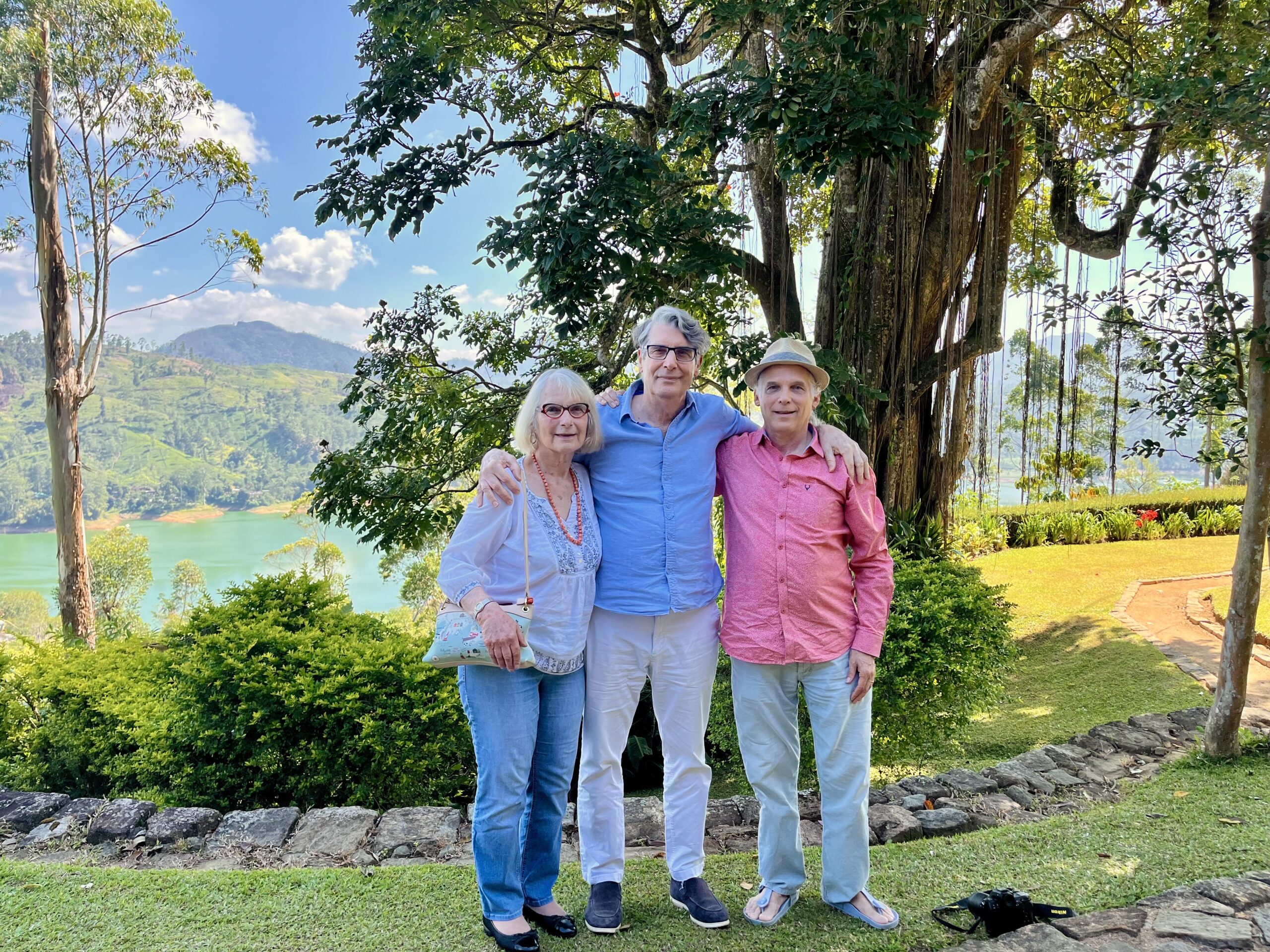
CLASS OF 1976 | 2025 | FALL ISSUE

Mark your calendars! The 50th Reunion will be held May 21–26, 2026. Because it’s our 50th, there will be special events on Thursday night just for our class. You have the option of staying in one of the dorms (or at a local hotel). Reservations for dorm rooms will open one day early for the Class of ’76. We should know late next winter/early next spring when we can register for rooms.

Changes to class notes: From this point forward, the alumni magazine (and, obviously, class notes) will be published only twice a year. Everything else remains the same, including the 800-word limitation for the published version. 
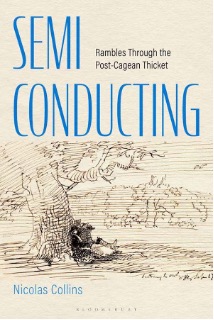
Nicolas Collins published a new book this year. This one wins my personal award for best title of 2025: Semi-Conducting—Rambles Through the Post-Cagean Thicket. You can find it on the Bloomsbury website. There’s a companion website featuring audio and video files mentioned in the book: https://www.nicolascollins.com/semi-conducting/.  
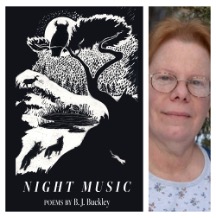
B.J. Buckley tells us about her latest book of poetry, Night Music: “My latest book of poems is just out in December 2024 from Finishing Line Press. It’s available on their website, on Amazon, and directly from me at wild4verses@yahoo.com. The gorgeous cover is by Wyoming artist Dawn Senior-Trask.”

Tom Kovar reports: “My son is now a college graduate. Oh, and I’ve run into Jay Kilbourn ’77, our former classmate (now ’77), a couple of times, as he now lives here in town. Other alums I’ve seen include Jonathan Gertler ’77 and Randy Austill ’81, who started as ’77. And John Daniel ’75 and Cynthia Ulman ’75. Maintaining email connections to a host of others, from ’75 through ’80.”

            Tom performed with his band, The Retroverts, at Luthier’s Co-op in Easthampton, Massachusetts, last April; Randy Austill  sat in and recorded the gig. You can hear them at https://bit.ly/Retroverts-2025-04-26_at_Luthiers

Matt Cartter writes: “My daughter Eileen is a staff writer at GQ magazine. Last week, she asked me if I would be willing to be interviewed for a Father’s Day article: “14 Style Rules GQ Editors Learned from Their Dads.

            “Eileen’s post, near the bottom of the article, starts with a photo of me and my brother, Chris, standing outside of the Butterfield Colleges in the fall of 1972. What a great Father’s Day present!”
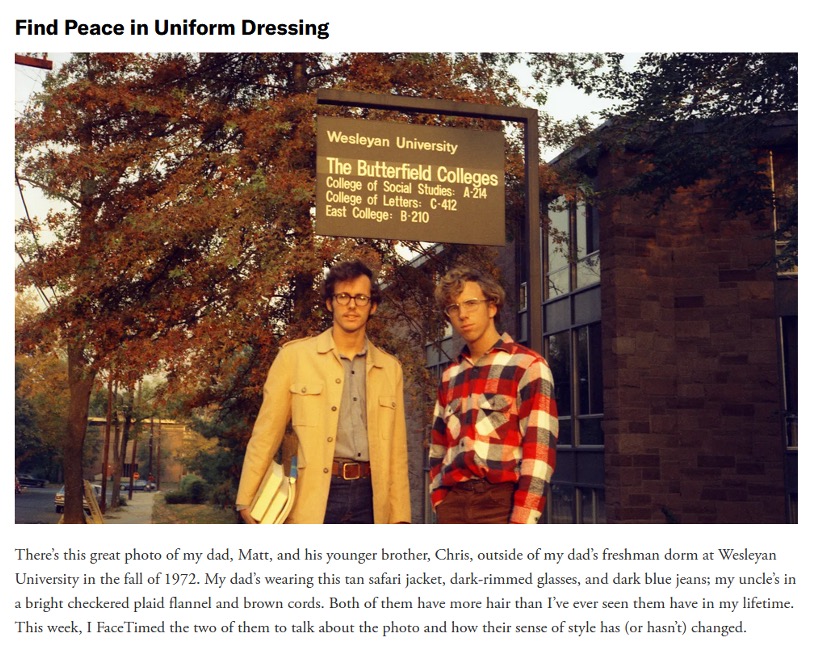
            Thanks, Matt, for including the photo!
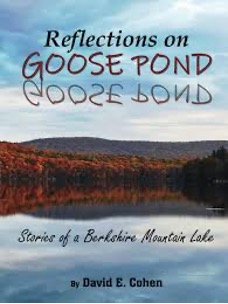
David Cohen writes: “I just published my book entitled Reflections on Goose Pond—Stories of a Berkshire Mountain Lake. This book was the culmination of a 50-year love affair with this little lake nestled high in the mountains of western Massachusetts—now very happily my full-time home.”

Tom Army tells us: “Dave ‘Duke’ Snyder died in October 2024, and the Wesleyan community, especially the ice hockey community, feel a great absence at the loss of such a remarkable coach, mentor, and friend. His memorial service was held in April in the Memorial Chapel. Don Lowery ’77 heads a committee of former players that established the David F. Snyder Memorial Endowment Fund to honor the legacy of Duke. We are very close to our million-dollar goal. My own family is well. My wife, Virginia ’79, and I live in Little Compton, Rhode Island, where Virginia serves as rector of the local Episcopal church. I continue to teach part time at a local community college. After retiring from the headmaster business, I went back to school full time and earned my PhD in history from UMass Amherst. Our five daughters, two granddaughters, and son-in-law are a constant source of joy and blessings.”

Susan Avitzour and Martha Meade had a mini-reunion! Susan was visiting family in Northern California and Martha made the most of the opportunity. Susan writes: “Martha Meade flew up here on Monday and stayed with us overnight. I hadn’t seen her since we graduated 49 years ago! We talked, inter alia, about our both being (kind of) refugees, albeit with good temporary homes and thus on the luxury track. Yesterday we went together to San Francisco MOMA. It was truly wonderful to have such a good chunk of quality time with her. Here we are at dinner Monday evening.”
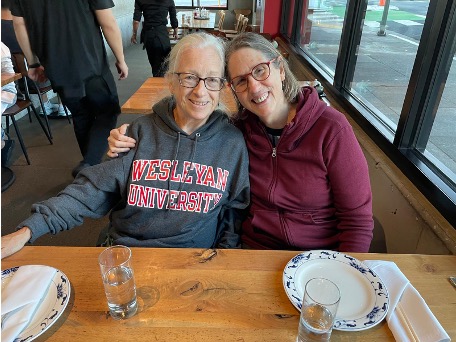
Susan Avitzour (left) and Martha Meade

Debra Haffner shares her good news with us: “My news is that I’m getting married to Joel Miller on October 19 this year in Boston. We are currently serving as the co-ministers of the First Unitarian Universalist Society in Newton, Massachusetts, and I’d love to hear from Wes classmates in the Boston area!”

Elyse Grasso says: “I have started a small publishing company, Superior Magpie Press, mostly to publish my own stuff. So far this year I have published two fantasy novels: Heir of the Bindings: Elderkin Chronicles Volume I and Broken Oaths and Boundaries: Elderkin Chronicles Volume II. Both are available in e-book and POD paperback from most online books sources. The third book is progressing and may be out by the end of the year.”

Deborah Lyons tells us: “After 21 years of teaching at Miami University (in Ohio), and quite a few years bouncing around from one institution to another before that, I have retired. Sadly, all signs point to this being an excellent time to get out of academia, especially for those of us in ‘unprofitable’ fields like classics. The trend away from the humanities led to my university getting rid of nearly all the language majors. At the same time, the Ohio legislature has banned DEI, making it hard to keep teaching my courses on ‘dangerous subjects’ like sex, gender, and religion. I hardly need to add to this the all-out attack on higher ed carried out by the current administration. Amid these depredations, I have been heartened by the eloquent and courageous statements by Wesleyan’s own Michael Roth ’78

            “On a happier note, our long campaign to unionize bore fruit and we just got our first faculty contract. 

            “I plan to relocate to New England within the next year. I am considering my native Massachusetts but also Connecticut and Rhode Island. Middletown is on my list. Advice is welcome! (lyonsd@miamioh.edu).”

Pam Raab reports: “Warm greetings to my classmates of 1976, from Pam Raab, who came to Wesleyan on the Twelve College Exchange and stayed for the rest of the college ride. I’ve been ever more grateful and proud of my WesU heritage as the years have drawn on. I live in Manhattan and have been a practicing psychotherapist (now part time, as I cruise toward retirement) for 45 years. Special memories of living in Michael Millen’s crazy house and screenings of Casablanca organized by Jay Kilbourn ’77.”

Michael Sachs reports: “Met Jay Abramowitz at Love Coffee on Ocean Park 90405. He had a cappuccino. I had the drip.”

Elisa Davis writes: “One of the best film art houses in the country is the Jacob Burns Film Center in Pleasantville, New York. They featured part of a video interview with me, [which was played] before some of the films shown in May 2025.

            “It’s on the main website right now (scroll down to the second video on the page), at https://burnsfilmcenter.org/support/connecting-our-community-film/ but after this month, I think the only way to see it is through this link: https://vimeo.com/1080226296

            “There’s also a tiny clip of me in this video, made for the year-end. Blink and you’ll miss me, but I can say I was in a video with Ron Howard:  https://vimeo.com/1032417262.

            “Last month in Philadelphia, I had a chance to have dinner and catch up with my Wesleyan roommate Connie Bodine McCann. What a treat!

            “In January 2021 (remember the pandemic?), I started a weekly virtual discussion group in which we each took turns choosing a film from the Criterion Channel to watch on our own and then discuss on Zoom on Friday nights. Remarkably, it’s still going on, more than four years later—although we now meet on Sunday evenings. There are a few Wes folks in the group, including David Low and Joe Reiff from our class, and my husband, Seth Davis ’72.

            “Here’s a link to the films we’ve seen: https://letterboxd.com/elisadavis/tag/criterion-film-club/films/.

          “Finally, Seth and I were delighted to host one of those Wesleyan alumni meetups in February. We had a light supper followed by a screening of Jean-Pierre Melville’s Army of Shadows. None of the attendees were at Wes at the same time. They included Dylan Osborn ’05, Sabine Celestin ’00, Peter Treffers ’63, and Matthew Spain ’95. It was a wonderful evening, and I hope there will be another opportunity to do something similar.”

Nat Needle says: “At my piano students’ annual recital on June 7, 30 students, kids, teens, and adults, all brought their authentic personalities to the keyboard and made a lot of beautiful music. During our international potluck reception afterward, many students and their parents remarked on the sense of community they experienced within this artistic group. Naturally, I was pretty happy to hear that! The theme of genuine community continued over the July 3–6 events celebrating the 50th anniversary of Oddfellows Playhouse. I got to spend precious hours with old friends, most intensively with OP co-founder, Alida Jay Boye ’76, down the hall from me in the same lodging! For the Oddfellows Playhouse 50 documentary, reunion photos, and more: https://www.oddfellows.org/.”

Joe Fisher was named the 2025 Hinghamite of the Year:  https://www.hinghamanchor.com/joseph-fisher-named-2025-hinghamite-of-the-year-he-does-so-much-for-the-community/

See you in May 2026!
CLASS OF 1975 | 2025 | FALL ISSUE

What a Reunion! The Class of 1975 beat Wesleyan’s attendance record for a 50th Reunion with 123 present! 

I can’t possibly capture and convey the weekend’s joy. It felt like the last week before graduation, when our time together seemed so precious because it wouldn’t be guaranteed once we left the Wes womb.

My apologies for not soliciting your news and Reunion stories in time for the Class Notes deadline, but my life’s been a whirlwind. My husband developed complicated vision problems requiring new doctors in arcane specialties and countless tests and visits. Our son’s wedding celebration in July—a beautiful event in an exquisite setting on a lovely day—required weeks of increasingly frenetic planning and errands in preparation to host dinners, brunch, and several houseguests.

So, this column shares some of my personal Reunion memories:

Driving into Middletown brought a wave of nostalgia . . . until I realized it’s not the Main Street I remember. It now bustles with offices, good restaurants, and shops, including the Wes bookstore located near where we hunted bargains at Bob’s Surplus.

Wesleyan is busy replacing or adding to buildings that it bragged about in 1970. Facilities staff led fascinating tours of the old, the refurbished, and the new. Highlights: the almost-finished Science Center; inside scoop on challenges and renovations at College Row and the Center for the Arts; evolutions in campus planning and architecture to promote learning and reduce costs and environmental impact.

In a lively co-education session, Bruce Tyson cracked us up reading from Where the Boys Are, a 1966 Mt. Holyoke/Smith pamphlet on road tripping. Erica Udoff observed that when she transferred in 1973, Wes felt like “it had always been co-ed.”  

Our welcome dinner started with a soggy bang under a tent at Pam and Paul Gionfriddo’s house. There were hugs, shouts, and lots of laughter as folks trickled in from the rain. No one sat still for very long; we were each trying to connect with everyone else at once.

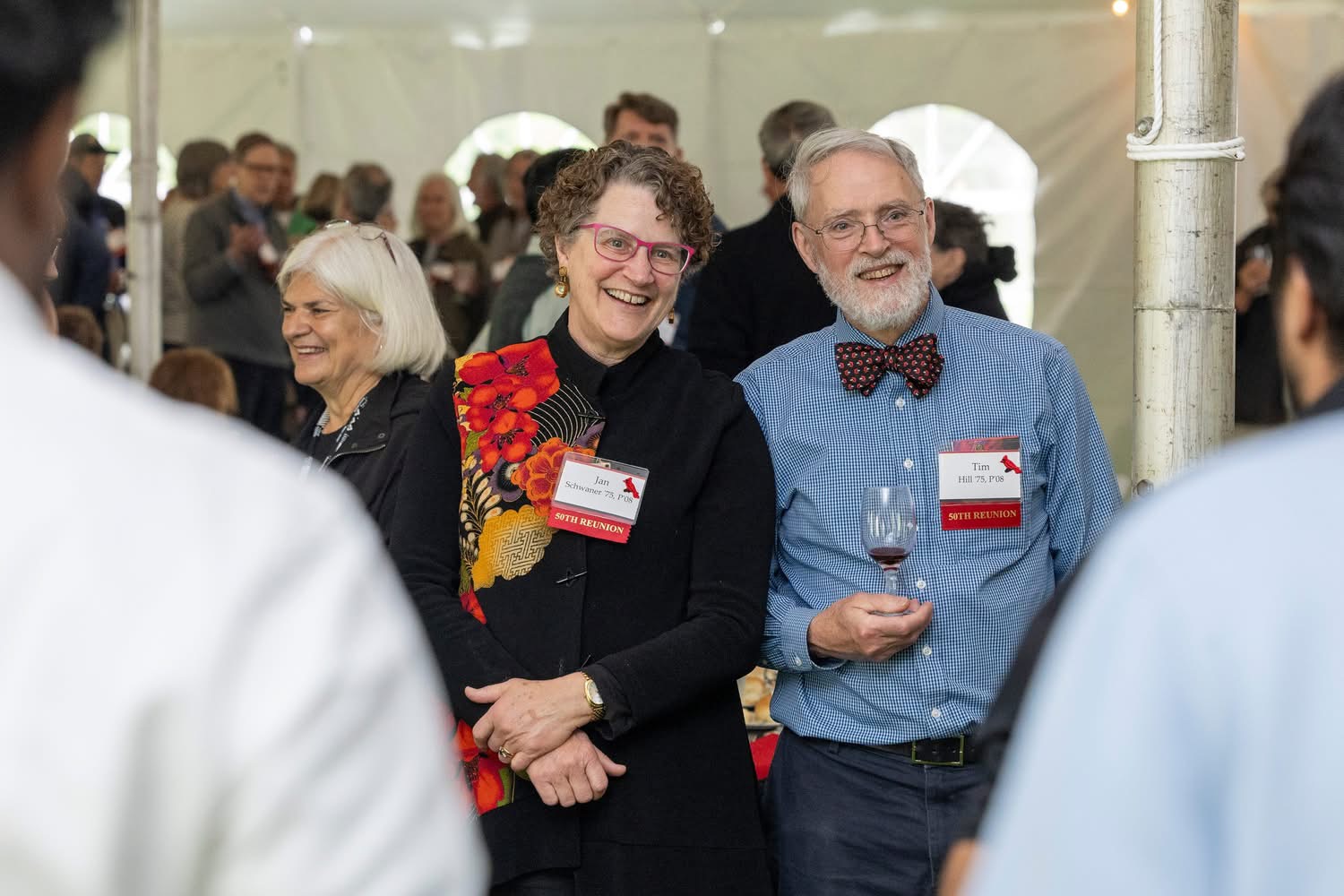
Fom left to right: Cindi Silverman, Jan Schwaner, and Tim Hill

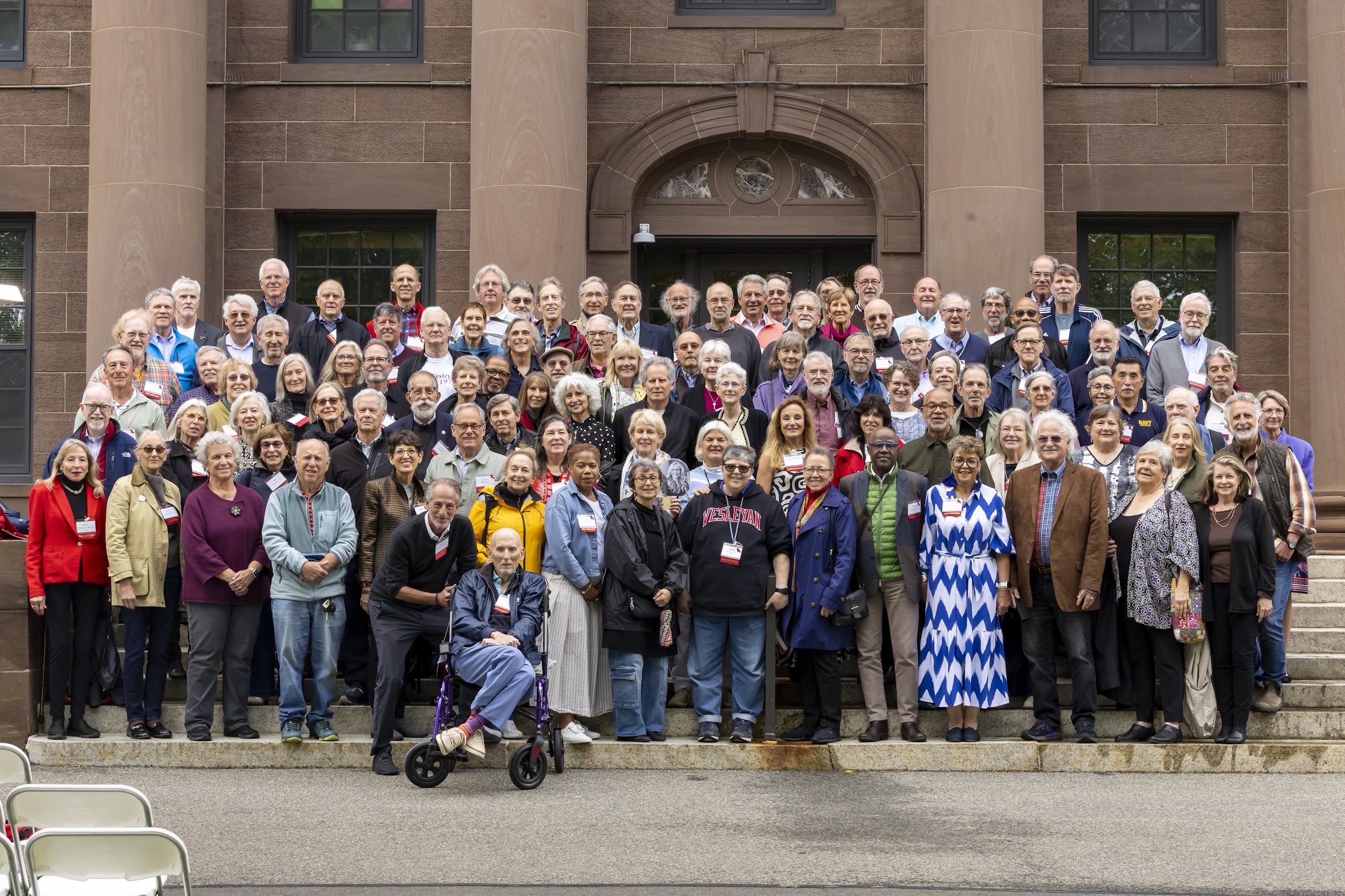
Charlie Stolper had been absolutely determined to be at our 50th. Christy and their son, Chad, came along from Texas to help him navigate the weekend in a wheelchair. It was wonderful to have Charlie with us, and he was seated front and center in our 2025 class photo!

May 24, 2025 : Day two of the Wesleyan University Reunion & Commencement Weekend.
(Image by Johnathon Henninger)
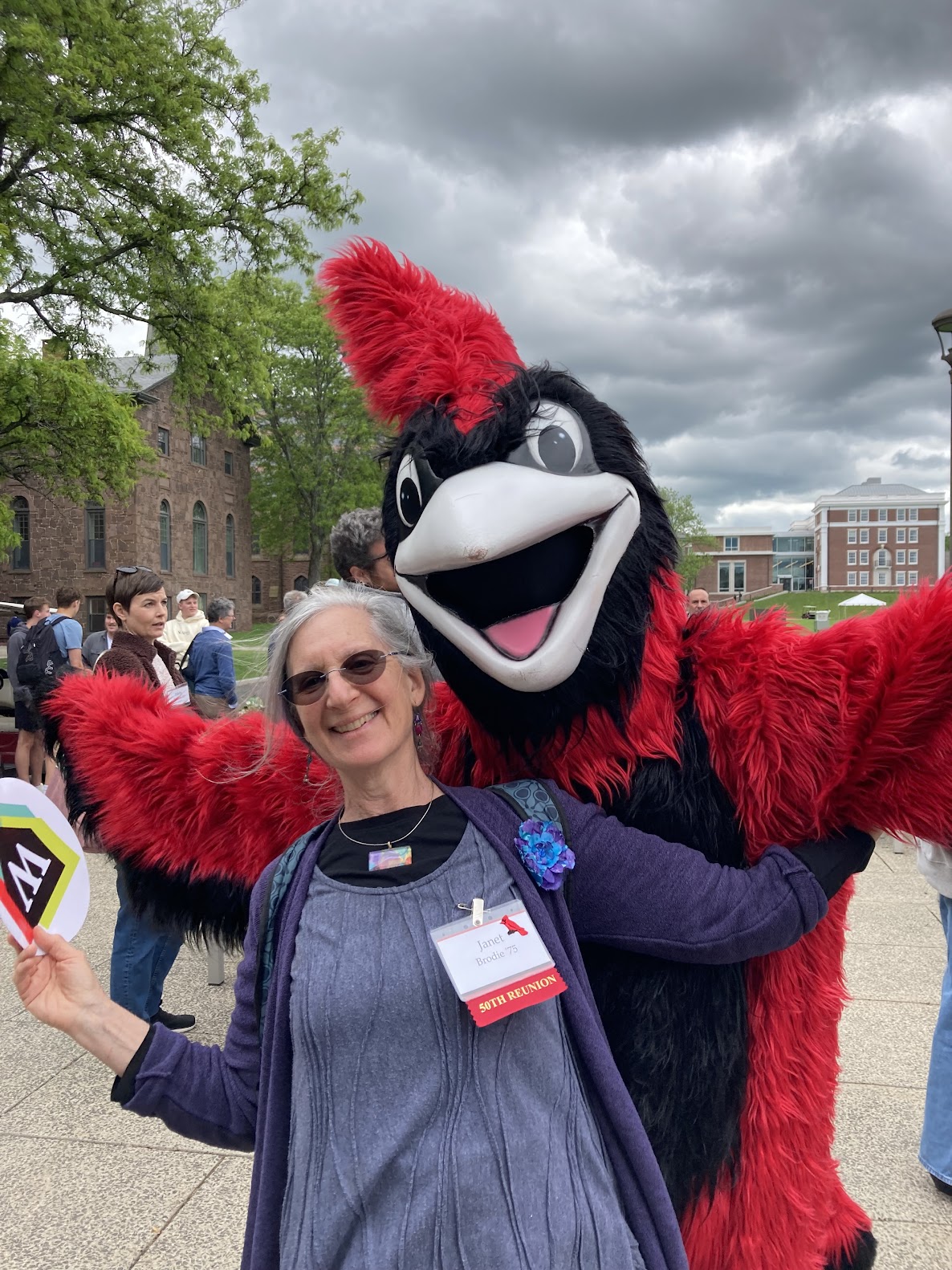
Janet Brodie with the Wes Cardinal

What those of us staying in the air-conditioned dorm atop Foss Hill most wanted was heat. Coats and umbrellas were essential with May rain and high temperatures barely reaching the 60s! After dinner each night, dorm dwellers, including Janet Brodie, Andrew Barnes, Martha Meade ’76 and Steve Miller, Karin Johnson, Risa Korn, Martha Faller, Susan Gans, Bruce Paton, Cutty Wilbur, Mark Nickerson, Jim Daly, Clif Grandy, his wife, Nancy, and others gathered in the common lounge for continuing conversation. There was probably a similar (but more comfy) scene at the hotel.

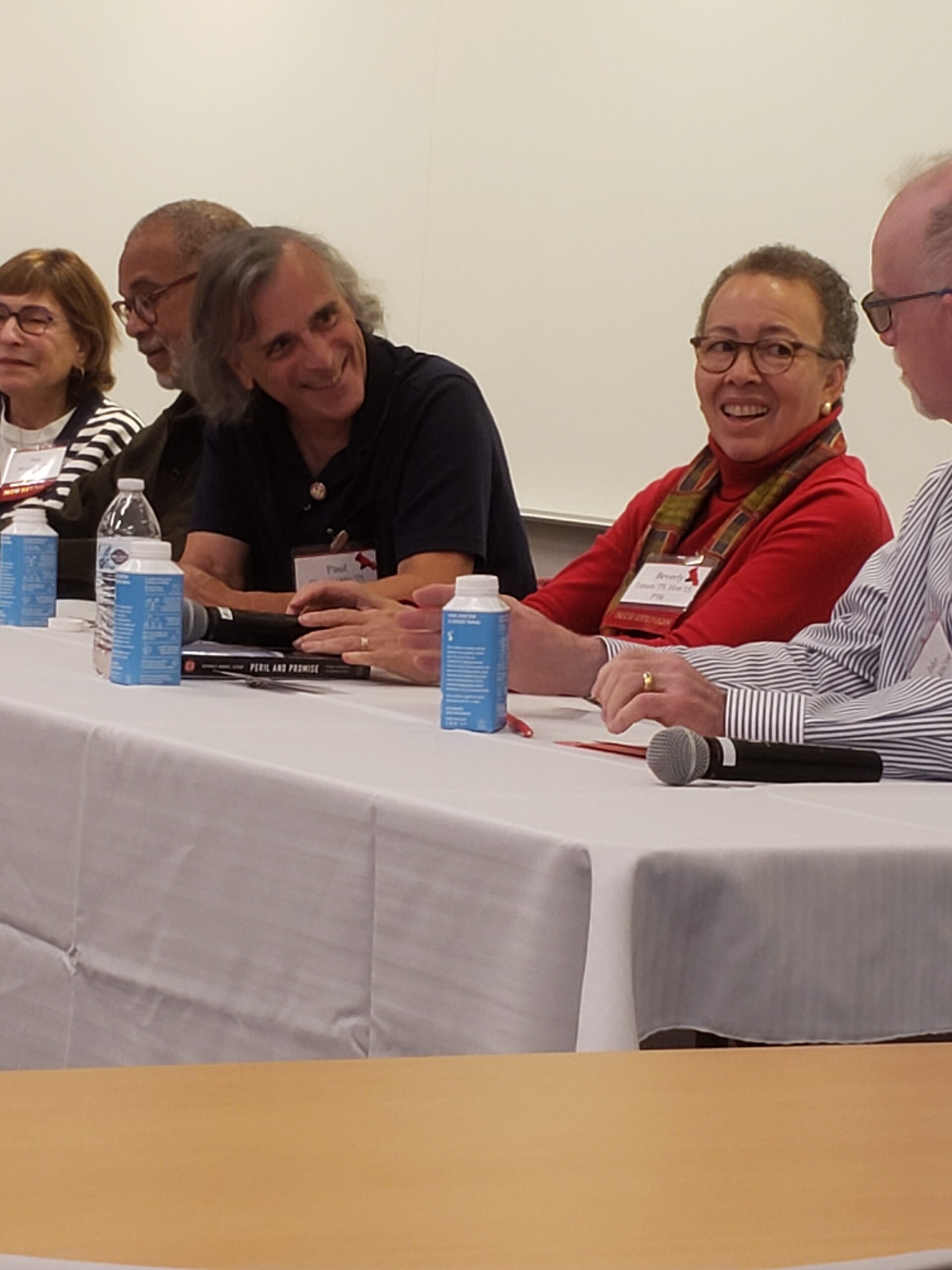
From left to right, Sue Moldaw, Clif Grandy, Paul Gionfriddo, Beverly Daniel Tatum, and JD Moore at their WESeminar.
 

Friday morning we passed microphones around so that 100-plus of us could each share something from our lives. Stories were by turns inspiring, funny, sad, surprising, impressive, and profound. WESeminars provided opportunities to learn more about some classmates: how Jeff Morgan went from music major “dropout” to kosher winemaker; Beverly Daniel Tatum reflecting with Michael Roth ’78 about college presidency; Amy Bloom’s path as a writer and teacher; Roberto Powers’s foreign service career and life as an expatriate. Saturday breakfast featured short heartfelt talks from Andrew Barnes, June Jeffries, Paul Gionfriddo, Bruce Weinraub, Doug DeNatale, and Erica Udoff about the difference Wesleyan made in their lives and how Wes propelled some of them down unexpected paths. The ability to study and perhaps become anything one could imagine, plus the resilience to change directions and continue learning were frequent themes about Wesleyan’s impact. Another frequent comment was how much everyone enjoyed talking to classmates who they’d lost touch with or hadn’t known well.

For many folks, the most moving session was a WESeminar performance by David Leisner and Elissa Ely ’78, called “Kindness, Sadness, and Steadfastness.” It evoked laughter and tears by combining David’s guitar interludes with stories drawn from Elissa’s personal and professional experience as a community psychiatrist. A small group of us had a video call afterward with Joost Brouwer in the Netherlands, bringing him briefly to Reunion.

My two most surprising highlights? 

  1. Lining up for the campus parade, I was surprised and delighted to run into my freshman-year boyfriend, Tom Wu ’72, for the first time in decades. 
  2. A group of 2020 grads back for their fifth reunion stopped a few of us to chat. They noted we seemed surprisingly healthy and young—not something it would have occurred to us to say about the Class of 1930! Looks like we’ve held up rather well, after all.
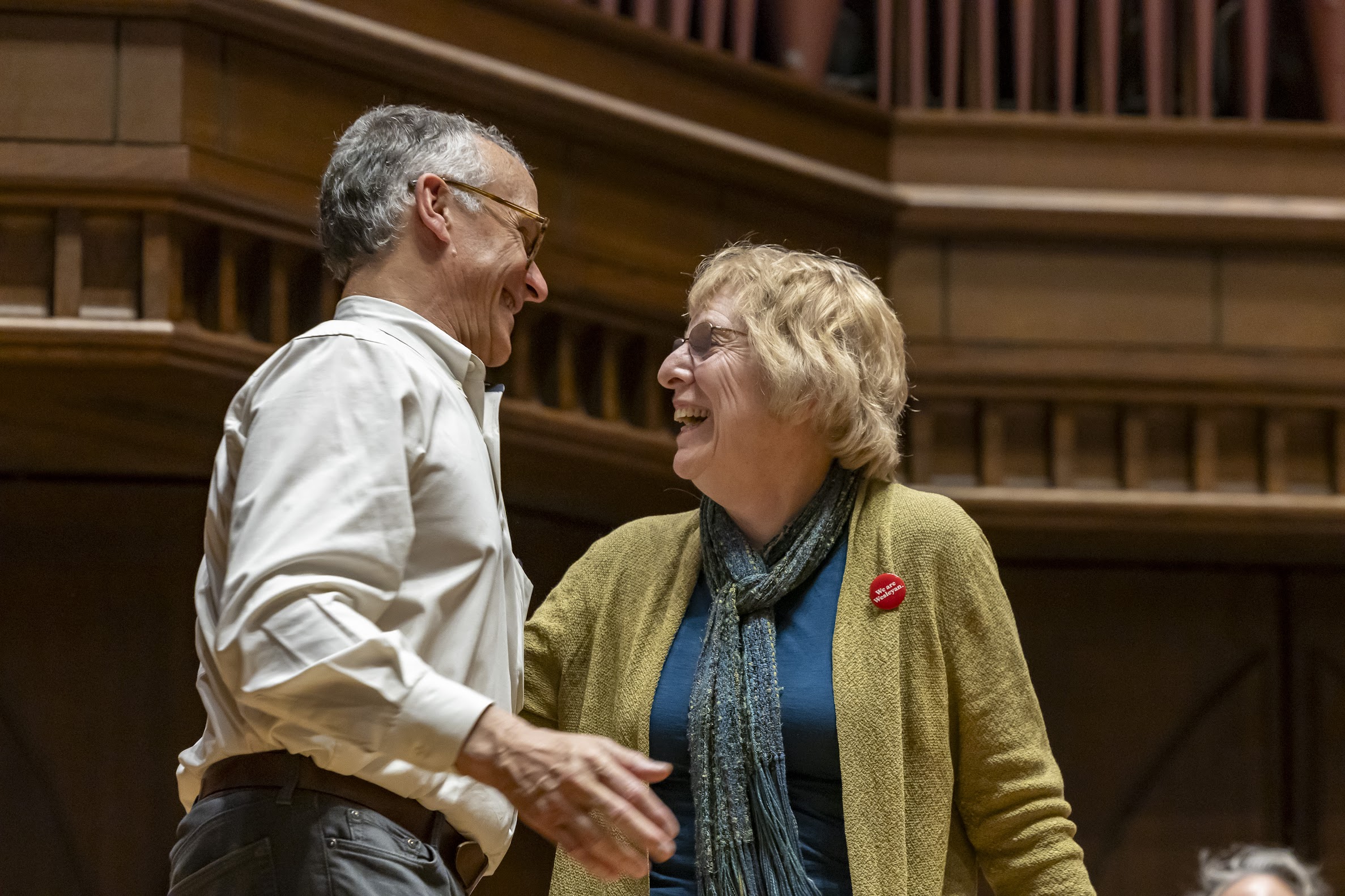
Day 2: President Michael Roth ’78 and Cindy Ulman, after Cindy was honored with an Outstanding Service Award.

Please share your memories, send me your news, and add your Reunion photos to our Google album.

CLASS OF 1974 | 2025 | FALL ISSUE

Richard Orentzel ’73 retired from his FAA job a year ago, which included writing/editing material for government testing standards and aviation handbooks. Some serious safety-conscious people hammer out these publications, but their names never appear in print. He is currently spending more time writing poetry. Here are some samples:

how to feel good in the USA

Though urges could empty a vault

Obsession to splurge cannot halt!

Surge spending can’t pause

Ending it might cause

Our mental gestalt to default

a presidential helicopter

While White House resident lovers

Can stay in bed under covers

Melania said

In her place instead

President Musk often hovers.

(Richard’s poems also include illustrations, but they couldn’t be transferred to this online note.)

Arthur Fierman received the Dr. Benard Dreyer Advocate for All Children Award presented by the Board of Directors of Children of Bellevue. This award was created in memory of Dr. Benard Dreyer, who dedicated his life to fighting for the well-being of children. Dr. Fierman worked closely with Benard for four decades and has deeply embodied the essential values that the award recognizes: kindness, equity, mentorship, and excellence in care.

The presenters of the award summarized Arthur’s work as follows: “Dr. Arthur Fierman is a distinguished pediatrician with more than 40 years of experience in general pediatrics at NYC Health + Hospitals/Bellevue and NYU Grossman School of Medicine. Throughout his career, he has served in various roles as clinical leader, educator, and researcher, always dedicated to improving care for children and families living in poverty. His roles have included director of Pediatric Ambulatory Care and co-chair of the H+H Pediatric Council, where he championed innovative health care delivery models to enhance child health and development.

            “As director emeritus, Dr. Fierman continues to engage in scholarly activities, mentors the next generation of pediatricians, and advocates for asylum-seeking families, furthering his mission to improve pediatric health care in New York City and beyond. He recently returned from the American Academy of Pediatric annual meeting where he presented the 2025 plenary session Support for Asylum-Seeking Children and Families: A New York City Perspective, highlighting the work of pediatricians and other health care clinicians at Bellevue and NYC H+H in caring for these children and families.”

Fred Kessler reports, “After 47 years practicing law at the same law firm, Nossaman LLP, I am retiring at the end of this year. My work has predominantly been for public agencies, assisting them with innovative procurements and contracting for major infrastructure projects. This has made my career meaningful, helping to enable projects that broadly benefit the public.

            “My family home is in Pacific Palisades and, needless to say, was affected by the wildfire that devastated our wonderful community in January. Our home, built in 1929, is one of the few to have survived the flames, although it is currently uninhabitable, contaminated with soot, ash, and dust with elevated levels of lead and mercury. And our separate garage that served as my wife’s art studio burned down and with it years and years of her artwork, the saddest part of this experience for us. We are living through the plodding, difficult process of decontaminating the house, rebuilding the studio, arm wrestling with the insurer, and finding and dealing with consultants, architects, and contractors. We have lived in five different places since fleeing the fire, literally wandering Jews, currently nestled in Culver City. But we have our home to go back to someday, unlike many friends and neighbors who lost all. To put it mildly, Pacific Palisades is a surreal landscape, and we are living a surreal experience.

            Wishing all my classmates beautiful days ahead, with fire only in your fireplaces”. 

Charisse Lillie was honored by the Committee of Seventy in Philadelphia on May 14, 2025, at their fourth annual Women in Public Leadership event, with a Civic Leadership Award, focused on The Power of Mentorship: Celebrating Women Who Carry as They Climb. C70 is a nonpartisan organization founded in 1904 to combat corruption in Philadelphia, which is currently focused on work designed to improve democracy and government in Philadelphia.

Charisse’s family is doing well, and she is enjoying quality time with her grandchildren. She is still enjoying her work as a board member on several corporate boards, a couple of nonprofit boards, along with some consulting work.

Bob Baum was in the process of uploading a grant application to the National Endowment for the Humanities, when the grant window disappeared. They will no longer fund overseas research. Bob continues, “However, I was delighted to give the keynote address (in French) for a conference in Senegal marking the 80th anniversary of the death of a woman prophet named Alinesitoue, who was arrested by the French [and] detained in a prison camp at Timbuctou, where she was the only woman, and died within a year of scurvy.  I wrote a book about her. It was exciting to speak about her in a country that regards her as a national heroine.”

After 35 years in San Diego (interrupted by 10 years at various stints in D.C.), Rick Kronick and his wife, Amy, have relocated to Berkeley to be closer to their older daughter and her delicious seven-and-one-half and four-year-old sons. Leaving La Jolla and close friends was hard, but the move, especially because Amy has both MS and relatively advanced dementia, feels like a good decision. A side benefit is being marginally closer to their younger daughter and her scrumptious seven and three-and-one-half-year-old daughters in Seattle. Rick continues to do research and policy work on Medicare Advantage payment policy, is a member of the board of the California Office of Health Care Affordability, and fantasizes about writing about how the U.S. might implement and govern a less dysfunctional health-care financing system after he retires from UC San Diego in the not-too-distant future. He has largely recovered from a couple of bad bicycle accidents and other medical misadventures, is greatly enjoying exploring Berkeley and environs, and is working at making new friends and figuring out how to make life work without his partner of 44 years, especially challenging because he is still living with and caring for her (with the help of a spectacularly talented and loving caregiver). 

Monique Witt reports, “It’s been an unusually busy time. We hosted an event for Wesleyan alums in February on Park—an evening of jazz and conversation about improvisation with Roger Grant, from Wes’s integrated arts program, and my son, Ben, at his Steinway B (video and recording included in case anyone wants to view).  We had a dozen alums and spouses, through recent young musicians to members of our own class. Bill and Jane Pearson joined us, and it went long. In the months following, Jane and Bill joined Steven and me for a number of jazz nights round Manhattan, and Ben caught up with their son, Howe (also a musician), at the New Orleans Jazz festival, where Howe was playing with his regular big band and Ben was playing with Rickie Lee Jones (the hometown girl). Dev has been in an intense product- development phase and ExMachina is buzzing in preparation for NAM. 

            “I am still doing board work, and the changing regulatory climate has increased the time demands. I’m gardening a lot to compensate for the wet, cold, and compressed spring and entertaining more for Steven’s work. Steven is still working hard, but is traveling more to Ben’s events, not as far as he did to the Azores last summer, but in the U.S.” 

Michel de Konkoly Thege updates, “I had the great pleasure of recently reconnecting with our classmate Don Reid, who is a professor of modern French history at the University of North Carolina at Chapel Hill. Don and I drove up together to Middletown in April, where I attended Don’s history Homecoming lecture on French conscripts in the 1960s. At this lecture, we also reunited with our mutual mentor, Professor Nathanael Greene, who was one of the hosts of the lecture. My wife, Harriette, and I subsequently hosted Don at a dinner at our New York City residence. This time with Don was the resumption of a valued friendship that has spanned much time and many mutual interests.”

Patricia Mulcahy shares, “I want to give a shout-out to Ellen Driscoll for organizing two protests on the steps of the New York Public Library. She was inspired by a March 7, 2025, piece in The New York Times that listed over 60 words and phrases that are now ‘disappearing in the Trump administration.’ On federal websites, no longer will you see the following: ‘environmental justice,’ ‘gender,’ ‘bias,’ ‘entitlement,’ ‘vaccines,’ ‘trauma,’ ‘peanut allergies,’ and ‘pronouns.’ Among so many others. 

“Ellen gathered a group of volunteers in her Brooklyn studio to paint these on placards that were then held up on the steps of the library. I didn’t paint, but I participated in both events at NYPL, along with Ellen and her husband, Steven, and members of a group called Rise and Resist. Claudia Catania joined us for the second one, a challenging session in a steady rain right before the No Kings march, punctuated by the chants of a passing parade of Hare Krishna adherents.  

            “Even in bad weather, we engaged the attention of passing tourists and others. And for the first one, some passersby even came up to join in. 

            “Ellen’s dedication to activism is consistent and unwavering. And that’s what gets results. 

            “Finally, I want to say that I’ve never been prouder to be a Wes grad than I am today. Michael Roth’s defense of intellectual liberty, free speech, and the values of democracy has been a complete inspiration.”

During Reunion 2025, we dedicated the bench and plaque celebrating our class of women who led Wesleyan’s return to co-education. The plaque reads, “In honor of the women of the Class of 1974 who led Wesleyan’s return to co-education. Given by the Class of 1974.” There were 20 to 25 at the event—women and men from our class, alums from other classes, and Wes staff. After I spoke, Phoebe Boyer ’89, chair of the Wesleyan Board of Trustees, spoke for a few minutes, thanking us for paving the way for women who came after us.

Some of the attendees of the bench dedication

I attended the memorial service honoring Colin Campbell. It was an uplifting event held in the Campbell Reference Center in Olin Library. Speakers included Phoebe as well as Karl Scheibe and two of Colin’s daughters, Blair and Betsy. Nancy Campbell and Chip Campbell also attended. Colin is buried in the cemetery next to West College.

CLASS OF 1973 | 2025 | FALL ISSUE

Peter Shumlin ’79 (third from left) and Mike McKenna (second from right) with leaders of the Nanjing Foreign Language School in China this April.

We have lots of news from Mike McKenna, who tells me that as he speeds toward his 75th year, “life continues to be interesting and enjoyable.” In April, he accompanied Vermont governor Peter Shumlin ’79 on a trip to visit schools in China, encouraging exchange students regardless of the current political climate. He writes, “Here we are with leaders of the highly regarded Nanjing Foreign Language School. Although not representing Wes in any formal way, we did leave Cardinal pennants at each campus we visited, which were well received.” He said later that month marked the 100th anniversary of Wesleyan men’s soccer on campus. Generations of former Cardinals attended and held career workshops with current players and played some lively alumni games. “I wisely did not bring my boots,” he said. Mike also said the busy day was “followed by dinner. Alums from the mid-60s on, including Rick Edwards in our class, Dr. Skip Nelson ’74, and former captain Dr. Pete Barnett ’72, who remembered taking my family on my first tour of campus with my folks and Coach Terry Jackson in 1969.” 

Mike also said through the leadership of co-chair Steve Levin ’75, “I’m happy to report more than $1 million has been raised by soccer alumni for our team endowment and for the athletic department. Wesleyan ranked 20th for total team wins in the country out of more than 400 D3 schools. Mike Whalen ’83 was deservedly named national Athletics Director of the Year. Having met former Wes athletes like Red Travis, Class of 1918, when I was an undergrad, I realize I’m now as old compared to current students as Red was to me way back then. And he seemed ancient! But that’s a century’s worth of one degree of separation which, is kind of cool.”

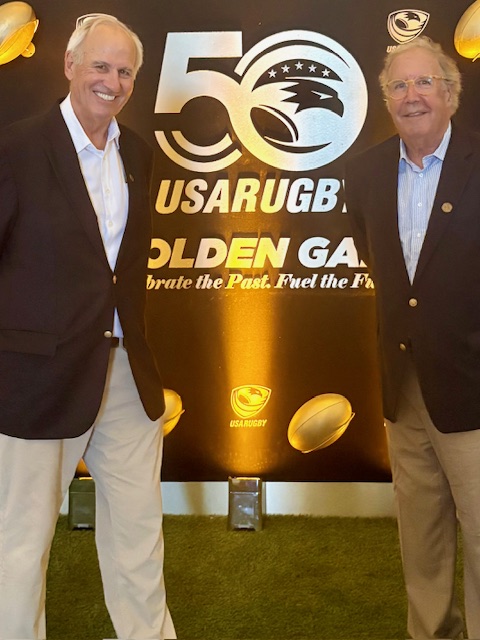
In May, Rick and Mike met again, along with classmate Rich Jasper, for lunch when he had to repay a lost bet on the Celtics versus the Knicks in this year’s NBA playoffs. Mike also said that our class’s Ahrens Award winner and our former teammate, John Hoder, attended the 50th anniversary of the United States Rugby Union Golden Gala in Washington, D.C., followed by a match between the men’s national team, the Eagles, hosting England, and our women’s team taking on Fiji.

John Hoder (left) and Mike McKenna (right) attending the United States Rugby 50th anniversary dinner in Washington, D.C., in July.

My many thanks to Mike for being such an incredible correspondent over the years, and I have to say I cannot get enough of his many wonderful photos posted on Facebook celebrating moments from Vermont.

We also heard from Jim Powers, who reports that he and his wife, Martha, celebrated their 50th wedding anniversary May 24 with friends and family at Rose Vineyards in Branford, Connecticut.  Congratulations, Jim and Martha!

Our world traveler and another faithful correspondent, Steve Young, reports that he is “still actively retired in Londonderry, New Hampshire, after a more than 33-year career in the American diplomatic corps, culminating as an American ambassador. Glad I am not still in government as the [current administration] has steadily shredded the offices I worked in.”

My former hockey teammate from freshman year, Bill Burke, has some news from Colorado. He tells me that he and Tim Mooney are working on a note about the Duke Snyder Endowment that has been established to honor Dave “Duke” Snyder’s 33 years of service to Wesleyan as the first varsity hockey coach. Bill says, “The money will go directly to supporting men’s hockey in multiple ways, including off-loading Coach Chris Potter of current duties, like fundraising, that aren’t directly related to coaching and recruiting.” Nice work Bill and Tim. 

Michael Fossel has been prolific. He writes, “I’m finishing my eighth book (almost every one of them was nonfiction, except for a novel under an alias). My agent is shopping this one around this month: Longevity—A Future beyond Aging. Should be out next year. I’m also contracted as the editor and senior author of another textbook for World Scientific for the year after that, with academics from around the world: Aging and Age-Reversal: The Prospects for Curing Age-Related Diseases. That will be my ninth and (hopefully) last book, as my time is now taken up with our biotech company. We now have full funding and will be moving ahead full speed.” How time flies. It seems like yesterday that we read his book Reversing the Aging Process.

Charles Cocores gathered with Wes friends in New Hampshire at Peter Cross’s house.

From left to right: Charles Cocores, Jim Raymond, Tim Donahue ’74, Peter Cross, and Mike Donnelly

I am hoping to slow the aging process as I continue reporting for the CBS–owned TV station in Doral near Miami. We have been able to make some trips to Colorado where my youngest daughter, Holly, has become a nationally known bookbinder in Highlands Ranch, not far from Bill Burke in Centennial, and where she also teaches bookbinder courses in Telluride. We have also gone up to Virginia where my oldest daughter, Jennifer, is an elementary school and Sunday school teacher in Gloucester (near Williamsburg) along with my oldest granddaughter, Taylor, who is also an elementary school teacher right next to where my youngest granddaughter, Zoey, attends middle school. My middle daughter, Dana, still runs a hair salon near downtown Fort Lauderdale called Hair by Dana and is constantly working social media to find new clients amid these competitive times.

Until next time,

Peter

CLASS OF 1972 | 2025 | FALL ISSUE

I received this report from Marc Bloustein:

“This past autumn, I retired after 50 years’ employment with the New York State court system. During my time there—as its legislative counsel and an advisor to the state’s court administrators—I worked for and with seven chief judges of our highest court and 12 chief administrative judges overseeing trial court operations. It was always stimulating work, and I was privileged to serve during a period in which court administration experienced a massive overhaul, one that gave me a real opportunity to influence the shape of court institutions and operations going forward. But, having reached my mid-70s, and with other things I wished to do, I decided that it was time to hang them up.

“In retirement, I haven’t abandoned all connection with the courts. I now work with New York’s chief court historian on a variety of projects exploring court system history. And so, I spend much of my time buried in dusty old treatises and court records and in writing monographs on obscure and not-so-obscure events in the life of our courts over the past four centuries. May not be the most exciting of retirement projects for some, but it gives me great satisfaction and enjoyment. I also spend a lot of time these days with my two grandchildren. Fortunately, they live close by, and I can see them almost every day. She’s 12 and he’s seven, and I can’t help bragging about them. She’s a dancer with eight years of classical ballet training and will soon be dancing—for the second consecutive year—with the New York City Ballet when they perform this summer at the Saratoga Performing Arts Center. She’s also become very proficient at modern dance and will soon dance with the Ellen Sinopoli professional dance company here in Albany. As for him, he’s a fine baseball player, remarkably intelligent, and ‘Dennis the Menace’ come alive.  Handsome as can be, with a twinkle in his eye, but too clever for his own good.  Keeps me on my toes.

“Meanwhile, my wife and children are doing well. Diane (Skidmore, ’75) continues to work as a computer analyst and programmer for our court system. She seems very content to head off to work each morning (I like to think it’s because she relishes the work and her status as being the sole Bloustein family breadwinner, but it’s just as likely because she may not be too keen to be together with me all day as she would be were she to retire too).  My daughter, Jessica (Wellesley, 2003), continues as a digital content editor for the local paper, the Albany Times Union, and as the producer of major podcasts about area events. My son, Andrew (Northwestern, ’06) has a job we sports fans could die for: living in Chicago and Detroit, he directs TV broadcasts of Detroit Tigers games (used to be Chicago White Sox games, but he switched to the Tigers this year) and football and men’s basketball games for the Big Ten Network.

“Now that I’m retired and on a fixed income, I’m hoping they continue to like me and support me in my old age.”

Recently, the American Chemical Societyrecognized Bob White! for his 50th year of membership in the society. Bob says he owes this longevity achievement to his fellow chemistry major, Frank Benson, and Wesleyan chemistry professors Paul Haake and Max Tishler; Tishler followed up post-Wesleyan and was integral in the direction of Bob’s career in science and medicine. Chemistry was what Bob came to Wesleyan to do, and chemistry was what he did. I should point out that I hear Professor Tishler mentioned as a lasting career influence by a great number of alums, all with successful careers in chemistry and medicine. How fortunate for Wesleyan that after a stellar career in pharmaceutical research, he came to teach and inspire.

For my part, I was honored by American Express for being a cardmember for 50 years. They sent me a lovely blanket, I suppose for keeping me warm in my rocking chair.

Bruce Throne writes: 

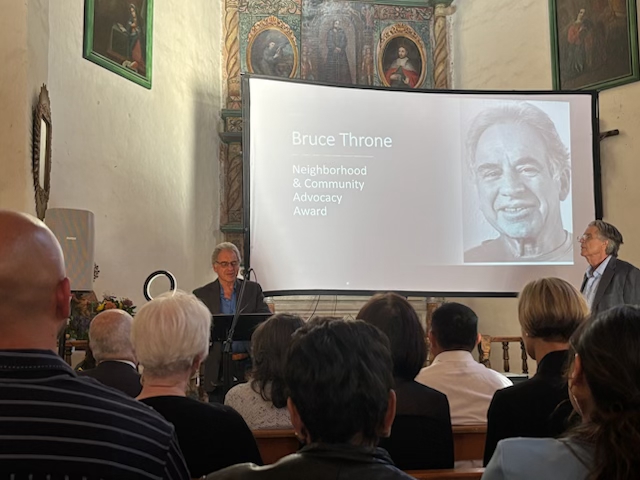
“Though I retired after 45 years from practicing law in Santa Fe in 2021, on May 15, I was honored to receive the Neighborhood and Community Advocacy Award 2025 from the 99-year-old Old Santa Fe Association for my three-and-one-half years of pro bono efforts using my legal background trying to save the city’s designated Old Pecos Trail Scenic Corridor, the last relatively unspoiled entry into downtown, from an Albuquerque developer’s 2021 rezoning and subdivision project that threatens the character of that scenic corridor. This community controversy has become a legal case (Bruce Throne, et  al. v. Governing Body of the City of Santa Fe) that is now before the New Mexico Court of Appeals.  The award was presented in Santa Fe’s historic San Miguel chapel, built in the 1800s on the Old Santa Fe Trail (photo attached).  Proof positive, I suppose, that in addition to what I gleaned  from my parents, Wesleyan gets some credit for teaching me that, like preserving democracy, preserving community and community assets is a never-ending struggle…even (apparently) in ‘retirement.’”

Bruce receiving the Neighborhood and Community Advocacy Award

Mike Kaloyanides and I were privileged to be invited to Andy Feinstein’s annual “Passover Seder Extravaganza.” Andy has traditionally prepared his own version of the seder to adapt the traditional message of freedom and liberation [in] current times. This year, in the age of Trump and Netanyahu, the challenge was high, and Andy met it with a journey through the protest music of the last century. We all sang such Passover traditionals as “We Shall Overcome” and “Draft Dodger Rag,” and I must note that very few of the assigned readers for Martin Luther King’s “I Have a Dream” speech, myself included, could get through their parts without bursting into tears.

Paul Vidich has published another marvelous spy novel, The Poet’s Game (his seventh). Several classmates attended a session at the Wesleyan bookstore during Reunion weekend when Paul was interviewed by the aforementioned Andy Feinstein.

Rico Birinyi organized a mini-Delta Tau reunion for classes of 1969–1973. Mark (not my son) Davis of the Advancement Office was marvelously helpful in making this event happen, and other special affinity groups should well consider setting up something similar during future Reunion weekends. I won’t attempt to name everyone who was there, but present from our class were Steve Blum, Jim Hoxie, Mike Boyajian, Larry Mendelowitz, Mike Carlson, Tom Wu, and Mike Kaloyanides.

We lost Leon Vinci this past spring. Leon was a constant presence at reunions and other Wesleyan gatherings. He was a constantly outgoing, hardworking supporter of our group ethos, contributing class regalia and other goodies over the course of many years, a proud son of Middletown, and eternal member of the Chi Psi Lodge. Here are just a few of classmates’ comments in response to the news of his passing:

            “A good public servant and a strong advocate for public health in Middletown and beyond.”

            “A spirited member of our rugby club and a good man.”

            “We first met on the soccer field freshman year. Wonderful guy.”

            “Didn’t know him much at Wes but enjoyed spending time with him at reunions.”

It will be hard planning our 55th without Leon, but you can bet we will do it.

CLASS OF 1971 | 2025 | FALL ISSUE

Aloha, classmates! Here is the longer version of your class note for this issue of the alumni magazine—more than twice as long as the 800-word magazine limit. Thank you for these wonderful notes.

Bob Yaro writes, “I retired 10 years ago from my day job in Manhattan, where I ran an urban policy group, and five years ago from teaching urban planning at Penn. I continue to engage in efforts to build high-speed rail in the Northeast and across the U.S. and to rebuild New York’s Penn Station. And I’m in my sixth year as chairman of the Herreshoff Marine Museum in Bristol, Rhode Island—reflecting my lifelong passion for classic boats. My wife, Susan (Smith ’72 and Wes 12 College Exchange), and I are headed to Nantucket and the Vineyard this summer on our newly restored wooden powerboat, where we plan to visit Blake Allison and his wife, Lindsay, at their place on Chappaquiddick Island. We delight in having our kids and four grandkids (ages 6–10) all close to home in Guilford, Connecticut —but unlike many of you who’ve lived all over the world, we’ve only gotten 21 miles from Middletown in 55 years!

From Stephen Ferruolo: “Time flies. . . . We are just back from Stephen’s (Wes ’20) graduation at SLS (Stanford Law). It was an impressive celebration, somewhat overshadowed by recent events. As much as the speakers tried to be encouraging to the new law grads and to inspire them to resist and not capitulate (as the nine prominent law firms have done), there was a clear sense that we are in uncharted territory, and no one knows where this all will end. Most evident was that there are likely to be many fewer international students at Stanford (and other U.S. universities) in the years to come.

“I have nothing much to report, other than Stephen’s graduation and that I have decided to continue to teach full time for a while longer. I continue to serve as a member of the Board of Trustees of Kuwait International Law School and was in Kuwait in May for a board meeting.”

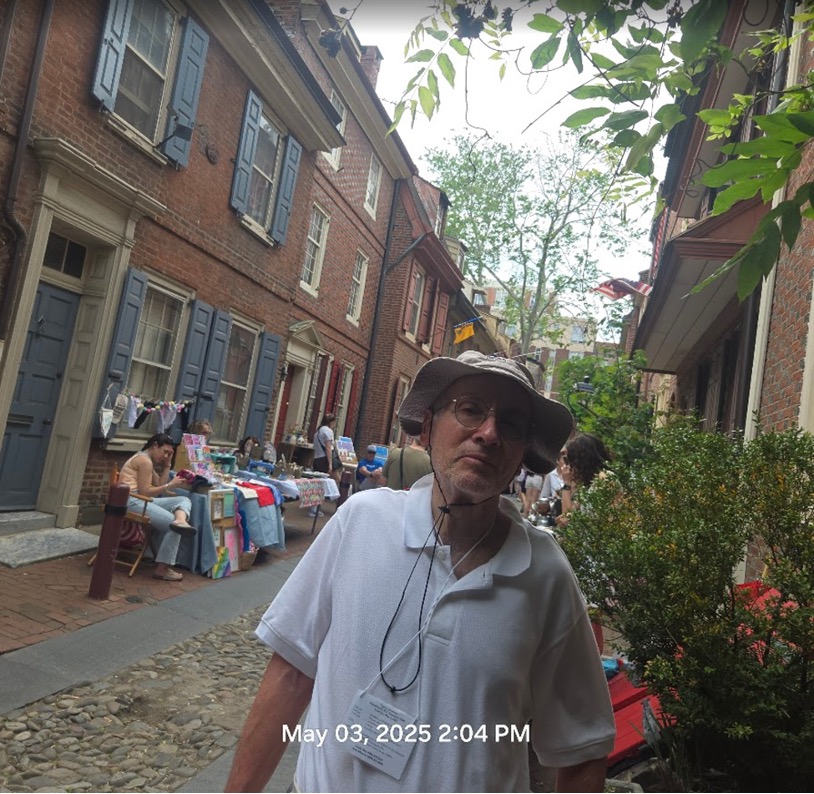
Warren White in Elfreth’s Alley in Philadelphia

Warren White says, “I recently joined a VMHC tour of Philadelphia, Pennsylvania, which is celebrating the 250th anniversary in good style. The tour included Elfreth’s Alley, possible work site of my indentured, 1745 immigrant-ancestor Joseph Wilkins Marshall. The Bellevue Hotel provided very comfortable lodging and while someone mentioned this was the origin of Legionnaires’ disease in 1976, it did not occur on our trip.”

C. B. (Kip) Anderson writes, “It’s been a long time. I always enjoyed our encounters, whether as fellow students or as alumni. Life is weird. I alternate now between fooling around with my three grandchildren and falling back on my longtime bad habits: gardening, writing poems, drinking single malt Scotch whisky, and cultivating cannabis. About the last, I must admit that it was much more fun when it was illegal, but its legalization is about the only thing I have good to say about Massachusetts.”

From Phil Rauch, “Officially retired the end of January 2025 after two years of ‘of counsel.’ We are spending the summer/fall in our house in Vermont, where I am volunteering, hiking, fishing, and playing golf. Also spending more time with the grandchildren. Still on the Wesleyan board but will go off next year. Still traveling a fair amount—last trip was to Morocco.”

And from Andrew Glantz: “Greetings from Scottsdale. Roberta Adams, my wife of 39 years, and I continue to enjoy life and work here in Arizona, although Roberta is retiring in January. She has been the director of Pediatric Bone Marrow Transplant at Phoenix Children’s/Mayo Clinic since 2002. I’m still making furniture and teaching furniture making and design. I taught at the Wendell Castle Workshop in June, as I did last year. This is an amazing school, situated in Wendell Castle’s old studio. We spent three weeks in April in Australia, most notably on an island in the northwestern part of the Great Barrier Reef, a great snorkeling and diving area. I’m in the throes of renovating our kitchen—we have been here for over 20 years, and it has just made it to the top of the list. Lots of changes and destruction and great fun. Come on out and visit!”

Andrew Glantz (left) with students at the Wendell Castle Workshop in Upstate New York

John Schimmel writes: “I had the opportunity to visit Bob Wienner in hospice before brain cancer took him from us in June of ’24. (His obituary can be read here.) Bob was pretty thoroughly nonverbal by then but, blessedly, he could still laugh. We did a lot of that, especially on the day our Wesleyan roommate Jeff Waxman ’70 joined us. And speaking of Jeff, I just learned that we are going to be in London at the same time in August, great news since we don’t get nearly enough time to visit. Jeff will be visiting his son. I’ll be in the UK for work for most of the summer (I’m still producing narrative content for Cloud Imperium Games, and I’ll be seeing a first cut of a generative AI film I’m producing), but then my wife and two of our three kids are meeting up in London at the start of a much-overdue holiday for Maureen and me: London for fun; Manchester, so she can see the game studio; Edinburgh for the theater and fringe festival; Dublin for more theater. Our youngest has been living with us as she solidifies her transition out of college and into the workforce, but she’s looking to move out soon. Empty nest awaits us.”

From Katy Butler:“I’m not sure I’m transitioning. I still cling to my identity as a writer and often get up at 4 a.m. to write, though it’s harder to find publishing outlets, due to my age and changes in the media landscape. (I think I already let you know I was a finalist for a National Magazine Award in 2025 for an article in Tricycle, the Buddhist magazine.)
Exercising has become a half-time job, necessary for my survival and ‘healthy aging.’ I have to follow the advice in my own book (The Art of Dying Well). I swim three times a week at a community pool and just started weight training at the local community center. My energy isn’t what it was: I take a nap every afternoon or I’d fall over like a redwood tree. I have returned to my earlier infatuation with Zen and joined a local sitting group.

“In the meantime, my relationship with Brian Donohue, my second husband, continues to deepen. His touch gets more tender, I grow more honest and open, I get along better with my two stepsons, and we both get happier, more self-aware, and more grateful.  We are both in awe of what’s possible so late in life. We aren’t rich, but we’re lucky enough to have no money troubles and no debt and to live in a beautiful place, two blocks from a Whole Foods. (You should see the camellias in the backyard when they are blooming in late winter!)

“We have updated the upstairs bathroom and added grab bars. We know we should add a walk-in shower downstairs but find it too daunting! Projects I would have rushed into decades ago with little anxiety are emotionally harder now. 

“Brian continues to lead sing-alongs once a week in a memory care unit—they respond to him more and more by the week. It’s a ministry, a calling, and the source of a little income. I am working on a memoir of growth and healing, still trying to slim it down and figure out what the ‘plot’ or elevator speech is and mindful that it can’t include everything about my adult life but the kitchen sink. I have lost my hotshot New York agent over this project, which she abhorred. It’s a labor of love, not a money project.”

And a non-transition note: From the proud poppa, a press release from Steve Leinwand about his son, Ethan ’05:

Scott Joplin International Ragtime Foundation

Featured Performer: Ethan Leinwand

Blues-Rooted, Barrelhouse-Rich—The Soul of St. Louis Piano 

Ethan Leinwand brings a powerful and deeply authentic voice to the world of early American piano music. Specializing in barrelhouse blues and St. Louis-style piano, Ethan’s performances are a raw, rhythmic, and riveting celebration of a tradition that helped shape the foundations of jazz and ragtime. His unique blend of musicality, storytelling, and historical depth makes him a standout in today’s traditional music scene. 

Based in St. Louis, Ethan is deeply immersed in the city’s rich musical legacy and has become a leading voice in preserving and promoting its distinctive sound. He is an active member of Friends of Scott Joplin, a St. Louis-based organization dedicated to honoring the legacy of the King of Ragtime. Through this work, he also helps organize and host the monthly Ragtime Rendezvous, a community-centered event that brings musicians and fans together to celebrate ragtime and early jazz. 

In addition to his work as a performer and advocate in St. Louis, Ethan serves on the Board of Directors for the Scott Joplin International Ragtime Foundation, where he plays a key role in supporting the festival’s mission and artistic direction. His involvement reflects both his passion for the music and his commitment to ensuring its future.

Whether he’s delivering a gritty blues number, an energetic stomp, or a soulful slow drag, Ethan captures the heart of a bygone era with integrity and spirit. His music is alive with character and history, and his performances leave audiences feeling as if they’ve stepped back in time—and discovered something timeless. 

We’re proud to welcome Ethan Leinwand back to Sedalia, where his artistry, leadership, and dedication to community continue to make a lasting impact on the ragtime world. 

That’s all for this time. Keep sending those emails on how you are progressing in this life. Take care and peace!

CLASS OF 1970 | 2025 | FALL ISSUE

I’m sorry to have to report the loss of two other classmates. Just as the last column was going to print, I received word that Bob Segal had died. Bob was a religion major at Wesleyan, then earned an MA and PhD in religion at Princeton. He went to Europe years ago after teaching at several colleges and universities in the U.S. He taught at several places in Europe, the last being the University of Aberdeen in Scotland. More information here and here.

During reunion, John Talbot wrote to let me know that his former roommate Calvin deGrasse had died on April 24. Calvin, you recall, was from St. Kitts. Here is a piece that I received from his widow, Elizabeth deGrasse:  

“Calvin Ivan deGrasse was born on December 15, 1946, to Doris Buchanan and Fred Crooke in the town of Sandy Point on the island of St. Kitts, in the British West Indies.

“A consummate learner from grammar school, Calvin earned the highest scores of his class and was subsequently featured in the local newspaper and radio station. He went on to earn admission into Wesleyan University in Connecticut during a time of great racial segregation and cries for equality and inclusion in the United States. At Wesleyan, he was among the first students of color to integrate the University, subsequently graduating in the Class of 1970.  In his later days, he would fondly remember the friends he made during his time at Wesleyan. Calvin continued to pursue his education earning a master’s degree in business administration from Columbia University in 1978. Bachelor of Laws with second class honors (lower division) in 2002 from the University of London.

“For a time, post-Wesleyan, Calvin returned to St. Kitts where he served his country as minister of communication under the Llewellyn Bradshaw administration. After leaving government, Calvin returned to the United States where he pursued various endeavors, including working at Mellon Bank, serving his community via his own company, Liamigua Shipping, and working at the New York Stock Exchange until his retirement.  

“Calvin was charming and charismatic. He had a great smile and a fantastic sense of humor. He was a natural leader and an excellent communicator. He could talk for hours, joyfully and passionately about history, politics, law, and family. He was loving, encouraging, supportive, and honest. He was generous with his time and resources, and he put the needs of his family and friends ahead of his own. He also loved to eat!

“After a long illness, Calvin transitioned to the ever after surrounded by his beloved wife and two children.

“He is survived by his wife of 22 years, Elizabeth deGrasse; siblings Jocelyn Tatum, Warrington Tyson, and Marlene ‘Pat’ Crooke; his daughter and son: Michelle deGrasse and Calvin deGrasse Jr.; nieces and nephews: Natasha Tatum, Warrington Tyson Jr., Tiffany Tyson, Brandon deGrasse, Lennox deGrasse Jr.; grandchildren: Daniella Semper, Hugh deGrasse, Jeremy deGrasse; and many in-laws and countless other family members and friends, some from his childhood days, who loved him dearly.”

We will miss him, as well.

Reunion was fun, although sparsely attended by classes celebrating post-50th reunions. The following folks made it to Middletown this time:  Bob Stone, Ralph Moore, Joel Adams, Jeremy Serwer, Josh Barrett, Pete Stein, Howie Borgstrom, Bob Ament, David Geller, Darwin Poritz, Jerry Schwartz, Jeffrey Elson, and me. As usual, there are new things to see and a variety of activities to attend. Two highlights were a presentation about what the future of the country looks like and a presentation by Wesleyan president Michael Roth. Dinners were with other post-50th classes.

Other news: Jerry Schwartz wins the brevity award. He commented about the reunion: “It was good to see everyone.” The second-place winner is Steve Masten. Steve wrote that he was “unable to attend Reunion because it coincided with (wife) Ann’s retirement celebration. Hope you all had a good time.” (We did!)

Right now, I want to urge everyone to start planning for our 60th Reunion. Let’s face it, folks, we’re not getting any younger. Let’s make the 60th Reunion huge!

In lieu of a standard news offering, Brad Matthews sent a very thoughtful miniessay about life, knowledge, curiosity, etc.: 

The wise man is one who, knows, what he does not know.Lao Tzu, Tao Te Ching.

“Perhaps like you. . .

“I increasingly recognize that I am no wise man, but I am enjoying feeling like I am getting a better understanding of this translation of Lao Tzu’s original words.

“I am focusing much of my remaining time collecting and linking information, seeing glimpses of patterns leading to flashes of understandings of existence.

“I incessantly cogitate on the increasingly obvious, unknowable, micro and macro expanse of reality—including, but in no way limited to, our bodies, minds, emotions, relationships, self-governance, societies, humanity, and our world, as well as the implications of quantum physics, quantum computing, AI, explorations of outer space, etc.

“I find myself noticing and reappraising the myriad of my life’s experiences—reconsidering and redescribing the particles and wholeness of my life. Relieving myself from judgements of past ‘should haves’ and current/future ‘shoulds’ is an enjoyable work in progress.

“As complexity and chaos are now more visibly outer and inner norms in reality, I find a kind of peace in coming to terms with the ying-yang of this life. Recognition, respect, acceptance, and appreciation for all that has been, is, and will be seems to bring me a calming sense of order. And so, I continue to function, similarly and differently than in times past. My functioning for hire as an international organizational development consultant has ended. Now, I focus my functioning almost wholly on my curiosity, caring about and with others (including my 14.5-year-old pup), peace of heart and mind, and maintaining my health to enable it all. I do not desire a long life. I just seek a rewarding life for whatever time I have left, hoping that at my completion I am relaxed and gently smiling.”

One of the pleasures of writing this column is the occasional appearance of someone who has been missing in action for years. This time, we welcome Andy Edlen. Andy’s email described a long career involving music, from working in Jimi Hendrix’s studio, playing backup for performers, “making music and sound effects for computer game companies, a brief appearance in a documentary about Hendrix, etc. Andy lives in the San Francisco Bay area. He writes:

“Apologies for my radio silence and nonparticipation. As the calendar careens forward, it seemed time to catch up. On the heels of graduation, thanks to a call Jeff Wanshel ’69 got from a high school friend of his, John Emulin, leader of a band called Lothar and the Hand People, who told Jeff of a job opening, I went to work at Jimi Hendrix’s Electric Lady Studios on 8th Street in Greenwich Village, a bare week before Jimi’s sad passing. Over the next couple of years, I went from gopher (go fer this. . .) to night manager to staff engineer. Lots of brushes with fame and brushes with the greed and venality of the record biz. The ensuing decades were filled with a blur of bands, some time on the road backing up Bobby Freeman (‘Do you Wanna Dance’ and ‘The Swim’ in a kind of white-boy soul revue. :-}. Then a couple of decades making music and sound effects for computer game companies in the Bay Area, where I’ve resided since 19(gulp)73. And over the last decade, I’ve been doing IT at UC Berkeley.

“My brother Steve and I have a number of songs up on SoundCloud at https://soundcloud.com/user-568633504 that you and your readers might enjoy. And I escaped the cutting room floor in a movie about the studio’s early days, findable on Amazon as Electric Lady Studios: A Jimi Hendrix Vision. The editors kindly included my sentient moments from the interviews, and it’s a pretty fair time capsule of that window in the studio’s history.

“I’m in touch with precious few friends from the era, and I hope this Class Notes appearance may help remedy that.”

Had a note from Jerry Cerasale. Jerry wrote, “The only news I have other than my knees are talking to me every day is that I was re-elected to the Eastham, Massachusetts, Select Board and was elected by the board to be chair. It’s a bit late to start my political career!”

This from Steve Talbot: “Here’s an item, as San Francisco Chronicle columnist Herb Caen used to say, I’ve been up to some wildly disparate things: I spent nearly three amazing weeks in Vietnam in April as an invited guest to mark the 50th anniversary of the end of the war. The trip of a lifetime. Emotional. Uplifting. Then I spent a weekend in LA in June reuniting, after 60-plus years, with Jerry Mathers (the Beaver) at a Hollywood autograph show, a first for me. It was nostalgic and a bit surreal. Came home to San Francisco to join an enormous, inspiring No Kings protest. What can I say? We keep on pushin’.”

Peter Ratner wrote from New Zealand: “Not much to report. As I think you know, we have sold Greytown [a gorgeous old country house] and are back in our old house in Seatoun [Wellington]. We miss the quiet of Greytown, but it is nice to be back by the sea.

“After almost 10 years of being tenanted, the house is looking a bit sad, so we are in the midst of a major renovation. Until that is finished our only significant outside interest is helping to look after our youngest grandchild.  

“We are planning to go to Scotland, London, and New York at the end of October for the wedding (after 20 years and two children) of our London daughter. Most of the kids will be there.

“Just saw the latest version of the Count of Monte Christo at the French Film Festival. When Edmond Dantes is in prison, the guards came along every day to bang on the bars and ask, ‘Are you alive?’, to which the prisoner responds, ‘I live,’ and gets his daily meal. I feel like this is now our version of the same ritual—I am pleased to be able to report, ‘We live.’”

Brian Silvestro wrote: “Retired after 50 years of practicing law effective January 1, 2025. Living in Black Rock, Connecticut. Our four sons live in San Diego and Colorado Springs and Chicago and Richmond. We have five grandchildren with another on the way. Jane and I can now travel as we please. And we are doing just that.”

Foremost Hawaii-water lawyer Bill Tam published a chapter on Hawaii water law (1973–2000) in Wai Wai (an anthology).  Bill, Hardy Spoehr ’66, and others organized the first Wesleyan alumni gathering in Hawaii in 10 years (Michael Roth is scheduled to address the group via Zoom).

Per Bill Tam: David Davis retired from a 29-year career at Oregon Public TV. Accolades from those Dave worked with and mentored are pouring in. His steady leadership and vision turned Oregon Public TV into the third-most powerful PBS station in the country, behind only New York and Washington, D.C. 

We have three offerings in our book department this time.

Jamie Kirkpatrick’s The People Game is the third in the Declan Shaw trilogy. It should be published by the time you read this. Here’s the synopsis:

“Declan Shaw is an Irish journalist who has just been named the Washington bureau chief of The Manchester Guardian. This follows his wartime assignments in Tunisia and Palestine, the settings of my two previous novels, This Salted Soil and The Tales of Bismuth.

The People Game, the third novel in the Declan Shaw trilogy, begins in 1950 when Shaw arrives in Washington. Over the next two years, he covers multiple important events: the Korean War, the senatorial and presidential campaigns of 1952, the McCarthy hearings on Capitol Hill, and the civil rights movement in Washington, D.C. Declan also meets and interviews several important personalities, among them Presidents Truman and Eisenhower, American spymaster “Wild Bill” Donovan, Secretary of State Dean Acheson, Congressman Jack Kennedy, civil rights activist Mary MacLeod Bethune, and many others.

“Declan falls in love with Tay Riggs, scion of the eponymous Washington banking family. They marry just before Declan is offered a visiting fellowship at Washington College in Chestertown on Maryland’s bucolic Eastern Shore. Tay, Declan, and their infant daughter Phoebee decamp from Georgetown and move to Chestertown where Declan leads a seminar in ‘new journalism’ and uses his contacts in Washington to bring an array of noted speakers to campus.

The People Game explores the events and people of an important era in American history. Moreover, its underlying theme is the story of Odysseus, his trials and tribulations after the fall of Troy, and his eventual homecoming, years later, to Ithaca. The People Game is the final chapter in Declan Shaw’s personal odyssey.

“The book is divided into 81 chapters, with a prologue and epilogue. There are also author notes.”

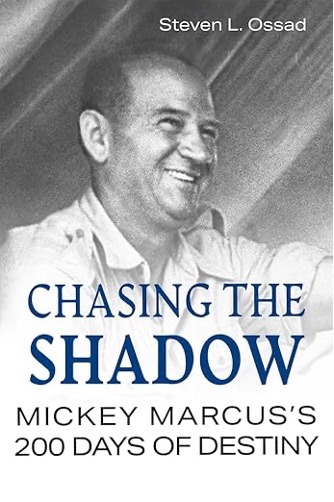
Steve Ossad’s new book is Chasing the Shadow: Mickey Marcus’s 200 Days of Destiny. Here is a brief description:

“More than just a citizen-soldiers’ biography, this book explores how local NYC hero Colonel David ‘Mickey’ Marcus helped shape U.S. civil affairs and military government policy during and after WWII, including the war crimes trials. Even more relevant today, from his visit to the just-liberated Dachau Concentration Camp to his appointment as Israel’s first general in 1948, Marcus’s last days dramatize the deep spiritual and national security ties between Israel and America. Chasing the Shadow offers a fresh perspective on shared military history, how legends arise, and the origins of American policy in the Middle East.” 

Steve wrote: “Attached is the press release for my third biography, Chasing the Shadow: Mickey Marcus’s 200 Days of Destiny, available on Amazon. My last book on General Omar Bradley won the Society for Military History Writing Award for biography.”

Press release:

“The life of David ‘Mickey’ Marcus has become the stuff of legends and myths (even fantasy), conspiracy, wild exaggeration, and untethered embellishment. The image of Marcus cast by the character portrayed by Kirk Douglas in the film version of his life still dominates most evocations of the man, for good or ill. And these days, reactions to the book or film rest mostly on the current headlines rather than the historical context of the struggle in which Marcus died, or the events that cast him as a real-life player in an event marked by destiny. 

Chasing the Shadow: Mickey Marcus’s 200 Days of Destiny is the first comprehensive and balanced biography of David Daniel ‘Mickey’ Marcus, a founder of American Civil Affairs and Military Government doctrine and practice and a seminal figure in early Israeli military history. Far from merely a tribute to Mickey Marcus’s legacy, Ossad’s work serves as a critical tool for understanding the realities of mid-20th-century warfare in a postwar colonial struggle and the dynamics of U.S.-Israeli military and political relations in 1948, the critical year for Israel’s struggle for independence. Indeed, Chasing the Shadow is a valuable read for those interested in Middle East history, Jewish military history, and a fascinating character whose story is told in an engaging, informative, and insightful narrative.”

Stuart Frank wrote: “My only real news is that my latest book, 35-plus years in the making, titled Biographical Dictionary of Scrimshaw Artists, is scheduled to be published in August by Amazon Books through Scrimshaw Forensics®. It has 1,450 biographical entries, 9 appendices, and 12 indexes.”

There was a book launch on Cape Cod in August, and the book is available online at  Books@ScrimshawForensics.net.

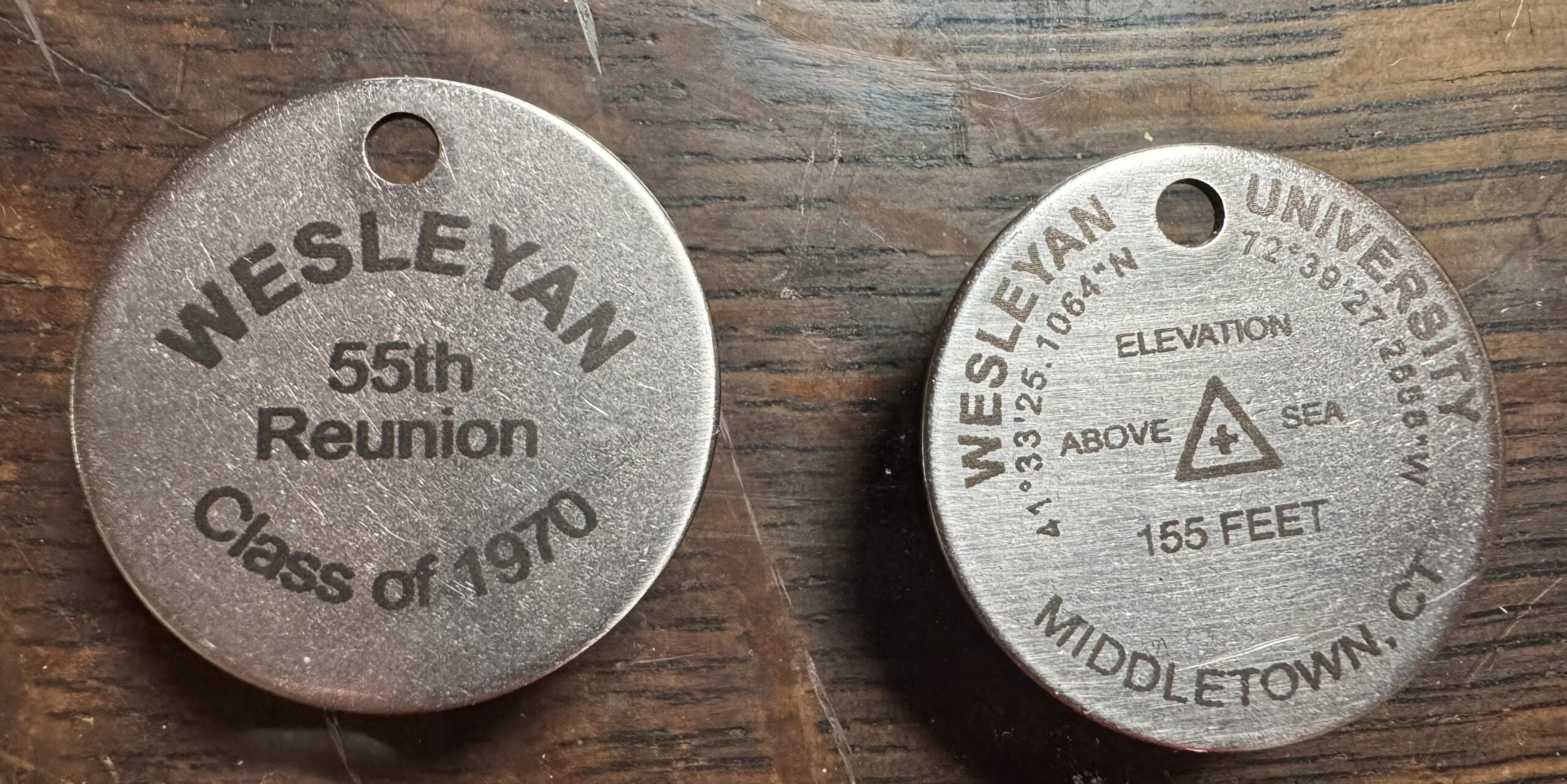
A limited number of keychains/zipper pulls commemorating the 55th Reunion are available.  One side has a geographical information about Wesleyan in the format of a geophysical marker.  The other side has the reunion information. If interested, please contact me by email.

CLASS OF 1969 | 2025 | FALL ISSUE

John Bach is “still the Quaker chaplain at Harvard and a painting contractor. I’m going out with my boots on.”


Chuck Taylor “spends time on Manhattan’s Upper West Side, in the Hudson River Valley, and traveling. Friends are welcome at either location. Bright lights, city lights, or beautiful, historic, lower Hudson River Valley.”


Fred Coleman continues as a “trauma psychiatrist for refugees in the USA.” He is a member of the Global Mental Health Learning Collective, with 18 teams in nine countries. (No surprise, the focus is trauma and mental health.) He says that his wife, two kids, and three grandchildren are well. This year he has traveled to Australia and New Zealand; to Maui with a daughter and her family; and to Lake George in the Adirondacks. Fred also attended a great 60th high school reunion at St. Andrews in Delaware; and he recommends reading Black Liturgies by Cole Arthur Riley.


Bill Eaton wrote, “I met my wife, Janet, 52 years ago in Madison, Wisconsin, while I earned a PhD in sociology. We spent five years in Montreal where I taught at McGill. After five years at the NIMH in D.C., I worked as a teacher/researcher in mental health for 40 years at Johns Hopkins. I edited a prominent textbook and developed a screening scale for depression disorder that’s in wide use. We live in Kendall Crosslands, a Quaker retirement community in Pennsylvania. I published a novella, Outward Bound. I make noise in a band called Sweet Potato Fries, reminiscent of my involvement in the Wesleyan jug band, Vulgar Boatmen. I enjoy supporting Michael Bennet ’87 for governor [of Colorado].”


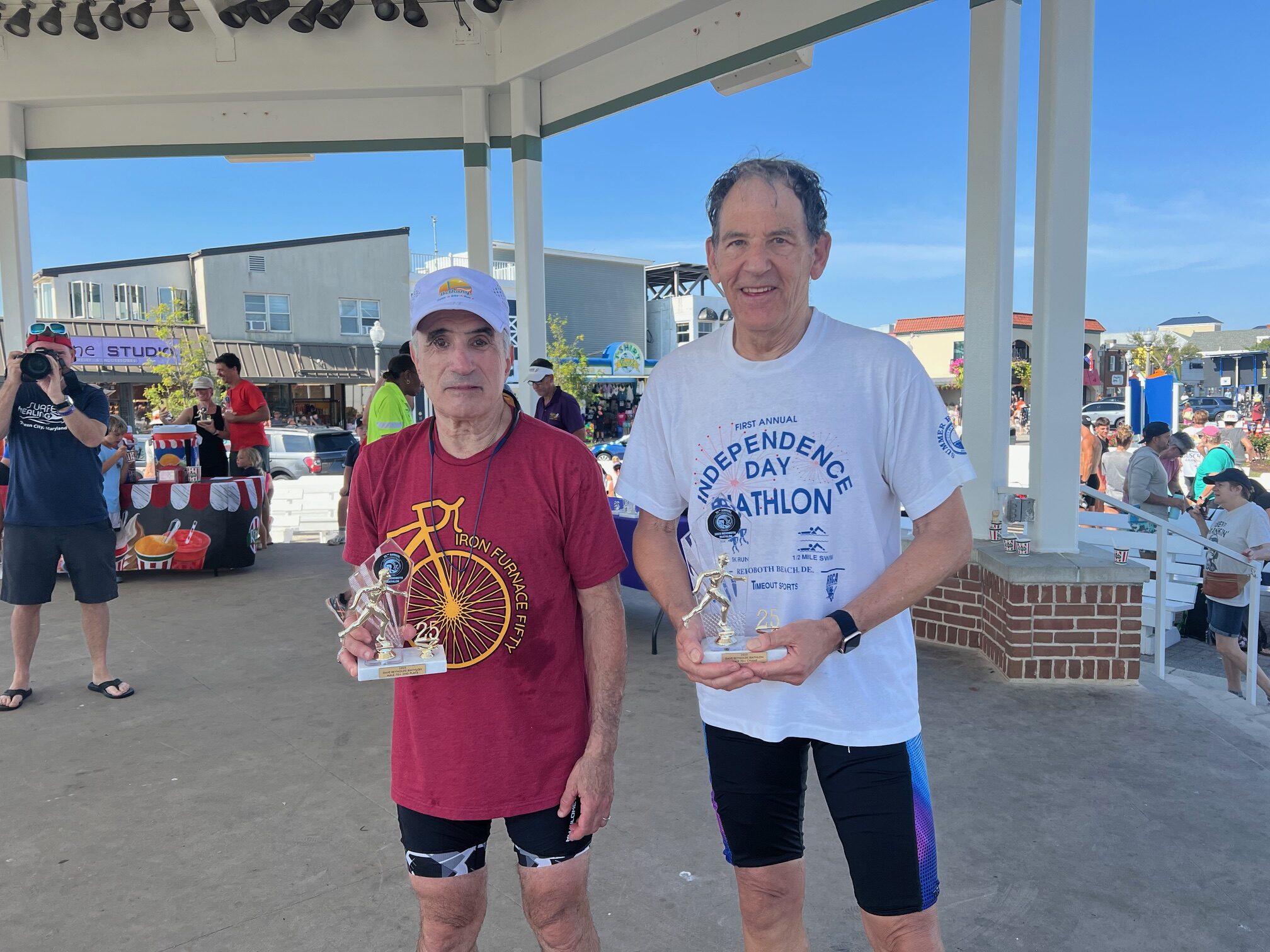
Harry Nothacker is “still involved in athletic activities. [I just completed] a swim/run biathlon in Rehoboth, Delaware, which I first entered in 1982. Silas Wild, and a navy roommate, encouraged me to start running. Since then, I’ve competed in about 400 races, with distances from one mile to Ironman treks.”

Harry, on right, at the Independence Day Biathlon in Rehoboth, Delaware

Dennis Marron wanted to let us know that he visited Wesleyan with his granddaughter, who he “thought was a fit. She, however needed ‘big-time football,’ so she chose Virginia Tech. . . . On another note, I have a grandson who plays football and lacrosse [and he] excels at both. Could be another ‘Hoy’s Boys’!”


Ken and Visakha Kawasaki are authors of multiple books and publications available from their Buddhist Relief Mission.

Stuart Blackburn wrote, “All good in Brighton (UK).” He has another novel due out next year; it will be set in 1940s San Francisco.

From left to right: Stuart’s wife, Judy, stepson, Michael, and Stuart

Phil Wallas sent in this sad news: “Class of ’69, Dr. Bill Demicco died in early July. He and his wife, Marie, lived in Scarborough, Maine. At Wesleyan he managed the unusual combination of pre-med studies and the demanding CSS program. He was a man of many talents: pulmonologist, father, husband, musician, painter, dancer, foodie, lobster-fest host, and more. If you knew him, you knew a thoughtful, warm, steady, funny friend for life.”

Steve Remmer also wrote of a classmate’s passing: “Jack Meier died [on May 30] after a long battle with esophageal cancer. He died at his dream home in Bluffton, South Carolina, with his wife, Claudia, by his side. Jack was a fraternity brother at Deke and roommate in New York when we both were enrolled at Columbia Business School. He was a good friend, and together with John Mihalec, the three of us spent many evenings at Deke discussing the war in Vietnam, race relations and the civil rights movement, sports, music, and women. It didn’t help our grades, but we became lifelong friends. During the past six months or so, the three of us were able to reconnect, joke a bit about ourselves, and remember those special times at Wesleyan. Jack will be sorely missed.” John added that “although Jack started out in our Class of 1969, he took some time off and actually graduated in the Class of 1970; and he played [on] the undefeated 1969 football team the fall after our graduation.”


John Lipsky ’68 responded to a Bob Dombroski comment: “I remember vividly the appearance of Janis Joplin and the Holding Company at MoCon. I was on the breakfast crew. As I sat having dinner, Janis and the band joined me and began talking. Their subsequent performance left no doubt they were headed to the big time. I saw some memorable concerts in the circular hall.”


Mid-July. Hot and wet in Old Saybrook. In cities and states around us, floods rip apart the landscape, our town a protected enclave. Daughter Liz, Josh, and family just left. The grandchildren go in many different directions at warp speed. Little speed for us. The locale offers shops, doctors, restaurants, health club, library, and theater. People I worked with are dying, multiple teachers and students this spring. The consolation—a Haddam/Killingworth reunion at Hammonasset State Park and a 60th high school reunion at Rockledge CC in West Hartford. Can’t forget Janis singing, “Ball and Chain.”

CLASS OF 1968 | 2025 | FALL ISSUE

Andy Gaus writes: “In a previous class note, I mentioned that I had self-published a songbook of some of my best songs over the years. It has since come to my shocked attention that some of you don’t read music. Accordingly, I have started to record a few tunes and make them available on my website, andygaus.org. I will be adding more tunes from time to time. So far, there is no paywall. Otherwise, I am well, still living in Boston, and generally attending reunions, where you might find me at the Alpha Delt house.”

Charlie Hill writes: “After 30-plus years working in public schools as a teacher, middle school principal, tech innovator, and district administrator—plus four years in the navy—I joined Sara, my wife, in her retirement from an equally engaging life in publishing. We retired a day apart, and a few years later, moved to the Kendal Continuing Care Retirement Community in Kennett Square, Pennsylvania. Lifelong New Yorkers, we originally had no idea where Kennett Square was—just that we wanted a CCRC that had the social justice ethos we found here. We have served on resident boards, joined many other activities, and created a digital archive that now holds and makes digitally available more than 50 years of community planning, living, political, and social documents. Most recently we have worked with other residents to send thousands of advocate letters to our elected officials, hoist signs on Route 1, demonstrate in Washington, D.C., and edit a Substack that helps inform resident subscribers and their families about those kinds of activities.”

Geoff Tegnell writes: “I assisted the Unitarian Universalist Church and the Dedham Museum and Archive in commemorating the 200th anniversary of Marquise de Lafayette’s 1824–25 tour of the United States as “the guest of the nation” with museum exhibits, school field trips, staging a play about “The Passing of Lafayette” [based on a short story by Elinor Ramsay] and reenactment of the general’s two-hour Dedham stopover on his way to Boston. (See https://youtube.com/live/NfRTiVLgr1w?feature=share.) I’ve also spent time writing the biographies of the 24 ministers who served First Church and Parish in Dedham since 1638. (See https://www.dedhamuu.org/visitors/our-ministers.) For the last three years, I have hosted our church’s Friday Folk Coffeehouse. Last summer my wife, Kathy, and I traveled to Scandinavia. Over the past 900 years, my forebears lived in all the regions surrounding the Baltic as part of the trade network established by the Hanseatic League.”

John Ashworth writes: “It has been 12 years since I retired from the National Renewable Energy Laboratory; and I have been a Colorado master gardener for the past 11 years, answering public questions at farmers’ markets, helping grow produce in public gardens for food pantries, and working two days a week as a volunteer at the Denver Botanic Garden. I have a personal year-round greenhouse and grow from seed mostly vegetables and Rocky Mountain perennials.  

“My wife, Nancy, and I travel a fair amount—my wife is a highly skilled amateur travel planner when she is not being an executive coach. As COVID projects I taught myself Italian and went back to practicing the Japanese language that I had learned as a high school exchange student and that I continued studying at Wesleyan. We went this past spring to northern Italy and the Italian part of Switzerland. To my surprise, I found I could communicate reasonably well with locals. When Nancy and I were standing in line outside a huge temple, I started singing an ancient Japanese song that I had learned in high school 60 years ago. To my surprise, I got 40 Japanese teenagers to sing along! They loved it. I loved it. Old guys sometimes can delight the young!

“So, life in Denver is good. We are healthy and always happy to host visitors and show them the sights.”  

Sandy See writes: “Emmy and I were on campus in June to attend a memorial celebration for Colin Campbell Hon. ’89. It was good to see many friends, including Dick Cavanagh and Steve Pfeiffer ’69, who gave a great tribute recounting his years with Colin as chair of the board. Also a treat to see Nancy and her now grown-up kids and grandkids. The formal portrait of Colin is a stunning resemblance and is in the Olin Library room named for him.”

Henry St. Maurice writes that he is running for a fifth term on the Columbia County (Wisconsin) Board of Supervisors District 21. His motto is “Don’t just march, run!” He is also on the board of Wright in Wisconsin, Inc., which promotes the works of Frank Lloyd Wright in their state. Henry and Mary invite fans of organic architecture to visit their home that was designed in 1954 by Wright for her parents.

Bill Johnson passed along a link to a recent Washington Post article about our classmate John Bates, a senior federal district judge in the District of Columbia  (https://wapo.st/4nTOUvF). The article described the ceremonial unveiling of his portrait and his remarks defending judicial independence amid rising political attacks on judges from the Trump administration. John, a George W. Bush appointee and former army veteran, has drawn criticism from Trump allies for rulings requiring the restoration of health-related web content and for halting the removal of DACA. Chief Justice John Roberts and several other Supreme Court justices attended the event, signaling broad support for John as a judge and judicial norms.

Jim McHale remains in reasonably good health, although he notes he needs to lose weight and grow more hair. He and Carol/Cookie recently celebrated their 57th wedding anniversary and welcomed two new grandchildren, a boy and a girl, both born this year. He is still working at the Securities and Exchange Commission as an attorney and ends his note, “All in all, mirabile visu!” Jim is looking forward to seeing classmates at our 60th and hopefully becoming a Powerball winner.

Eric Conger’splay, The Park, about the takeover by the government of a small midwestern town, received a stage reading in June at the Marilyn Monroe Theater in Los Angeles with a cast of Equity and SAG actors. It is the fourth such event in the last year, as the play’s big, beautiful march to Broadway rolls on. As if this weren’t enough, his screenplay about an adopted man searching for his birth family, entitled Bastard Nation, is currently completing development and looking to attach a star. Out of fierce loyalty to his peer group, Eric has limited investment opportunities for both these projects to the Wesleyan Class of ’68. Details to come.

Kenneth Schweller says, “I continue to work on NIH and other grants, investigating ape cognition through the use of video-game tasks. In July I gave a talk at St. Andrews in Scotland on Designing video games and using AI for ape research.  In September I will give a short talk at the American Society of Primatologists in Chicago about Kanzi’s legacy. Kanzi was a bonobo I worked with who could converse with humans using a symbol keyboard. In December I will head to Amsterdam to give a talk on using AI to simulate ape behaviors for comparison with collected data. My wife of 52 years died last December, and I am trying to keep as active and engaged as possible.”

Don Logie writes, “I recently made my 21st-century debut as a choral singer in a summer festival chorus. The theme of the festival was before Bach and beyond.  The festival organizer and sponsor was Connecticut Choral Artists (CONCORA), a 40-year- old professional choir based in New Britain, Connecticut. About 12 of its singers provided the chorus backbone. The conductor was Chris Shepard of CONCORA, clearly a leading world Bach choral expert. I really didn’t think I could do this, but I held my own and was very satisfied (and relieved) at the end.”

Bob Knox: “I ran the Dipsea race again in June; 7.2 miles over a ridiculous, but wonderful, single-track trail that includes about 800 stairs, 2,200 feet in elevation change, endless roots and rocks, and 1,600 runners having a glorious day together. I am one of the slowest runners in the race at this point, but my joy is simply being on the mountain with many dozens of friends. The next week I flew to Italy with my girlfriend/partner. We shared four weeks with my sons and grandsons doing a ‘hut-to-hut’ adventure in the Dolomites and hiking around Cortina d’Ampezzo, and we ended in Venice. Returning to California, I joined about 20 Wesleyan classmates on our bimonthly Zoom call. Our sense of community is palpable and being strengthened by our calls. I also wrote a letter to the editor about immigrants committing fewer crimes than native-born U.S. citizens, which was published in my local California newspaper and in the local paper in Springfield, Massachusetts, by my son who lives nearby. I am doing my best to strengthen all of the relationships in my life.”

John Mergendoller: “I am enjoying our monthly Wesleyan Zoom chats—it’s great to see and talk with old friends and make new ones. Bob and I urge others ’68ers to join. Contact Bob (bob@robertknox.com) for a link and prepare to be pleased and surprised. As for other activities . . . I spent a week this summer in Swannanoa, North Carolina, at a fabulous mandolin camp, and left not knowing whether I should leave my mandolin in the trash or increase my practicing to 18 hours a day. Prudence won out and I brought the mando home. Jessica and I are off to Northport, Michigan, to spend time with extended family and our bicoastal children and grandchildren. This fall we have a hiking trip scheduled in the Dordogne region of France. The COL sent me to France in 1965, and my love affair with the country continues.”

We send our best wishes to all,

John and Bob

CLASS OF 1967 | 2025 | FALL ISSUE

Classmates,

Fewer obituaries this time around (but warning: there is one). Mostly, however, I bring you news from the living (at least, they were living when I wrote these notes).

Walter Beh wrote the following: “After Wes, I went to University of Pennsylvania Law School in Philadelphia and [afterward] practiced law there for a year. Then headed to Honolulu, where I practiced real property law for 44 years and was vice chancellor of the Episcopal Diocese of Hawaii for close to 30 years. By then I no longer owned a suit but was the proud owner of 50-plus Aloha shirts and was the grand old man to four children and 11 grandchildren. Kids were fine, but grandchildren are the best. Looking forward to our 60th Reunion.”

Bob Runk sent me his books about golf, designed to make people laugh rather than improve their game. They have titles like How to Line Up Your Fourth Putt and When to Regrip Your Ball Retriever. He did not start to play golf until the 1980s when he was working in the aviation and aerospace insurance and reinsurance business. One of his company’s biggest clients was Japan Airlines, and Bob’s boss and the Japanese director of their New York office played golf together. Bob’s boss told him it was “mandatory” that he, too, play golf, so he did. He started to jot down notes based on his observations of the game. The rest is literary history. The books sold well (over 70,000— a number unheard of in the academic circles in which I move) and even include a blurb from Rick Reilly, a Sports Illustrated writer of considerable renown.

Punch Elliott checked in from Wisconsin. Now retired, he practiced plaintiffs’ law for 51 years and was a judge for 15 years in the 1970s and 1980s. He has a wife (Pam) of 55 years, three children, and eight grandchildren. He and I are on the opposite poles of the golf spectrum. He plays 200 times a year and has shot his age five times—as those of you who read my class notes carefully know, I play once a decade and struggle to make double bogies on a par three course. He even coaches the local high school boys’ golf team: “The high school kids are the best to coach and the best to be around.” He got his nickname at an early age, and it stuck: “I universally use my lifetime nickname, Punch.”

And, sad to say, there is another death of a classmate to report. Bob Callahan died New Year’s Eve in Florida (he had been dealing with health issues for a number of years). Bob noted in his entry to our 50th Reunion book that he was the first in his family to attend college. In the 1970s and 1980s he was the president of a large labor union (7,000 members) and then shifted into fundraising for various universities in Florida. John Andrus shared a memory that reveals something about both Callahan and Andrus as freshmen at Wesleyan: “I’ll go on record for giving him credit for keeping me in school freshman year—we had Spanish 101 five mornings at 8 a.m., and if Bob hadn’t rattled my door each a.m., I’d have slept my way back to New Jersey.”

Andrus passed Spanish 101, graduated from Wesleyan, and worked for JPMorgan Chase. As he explained, in his email to me, “Spent my career in the trust business, and after vowing to stay away from the New York rush and work in a smaller pond, ended up through multiple mergers/acquisitions with JPMorgan Chase.” He and his wife, Penny, have four children and 12 grandchildren. “Most of my days are spent traveling up and down the East Coast to various athletic events so that I can give any one of the 12 grandchildren unsolicited advice.”

Finally, let me say that as a graduate of both Wesleyan (BA) and Columbia (MA), when I read Robert Kuttner’s article titled “Columbia’s Capitulation, and Wesleyan’s Pushback” in The American Prospect, I was proud to be a Wesleyan grad and embarrassed by my Columbia degree. I can say no more.